
Ledgers Academy Letter
The Daily Ledger: 9 September 2026
Block asks the OCC to charter Builders Bank & Trust, an uninsured national trust bank for bitcoin and stablecoin custody. PayPal opens PYUSDx, Consensys splits in two, and Brent settles above $100.
Subject: Block wants a bank charter that holds no deposits
Preview: An uninsured national trust bank for bitcoin custody, PayPal opens a stablecoin issuance platform, Consensys splits, and Brent settles above $100.
THE DAILY LEDGER
9 September 2026
Block asks the OCC for a custody charter, PayPal lets businesses mint stablecoins backed by its own, and oil closes above $100 for the first time since July
Editor's note: market data reflects the 23:59 UTC daily close on 9 September 2026 (01:59 Europe/Stockholm on 10 September). News was checked to 23:00 UTC.
Block disclosed on 8 September that it has asked the Office of the Comptroller of the Currency to charter Builders Bank & Trust, N.A., a national trust bank for bitcoin and stablecoin custody. It would take no deposits, make no loans and carry no federal deposit insurance. That combination is worth understanding before the phrase "crypto bank" spreads any further.
1. The Day in Numbers
- Bitcoin: $78,306 at the 23:59 UTC close, down 0.2 percent over 24 hours.
- Ether: $2,468 at the 23:59 UTC close, down 0.7 percent over 24 hours.
- Fear and Greed Index: 66, Greed, three points below Tuesday and the lowest reading since 3 September.
- US spot bitcoin ETFs: $46.6 million of net outflows on 8 September, the last completed session, ending a three-session run of inflows.
- Brent crude: $101.21, up 3.36 percent, its first settlement at $100 since July.
2. What is an uninsured national trust bank?
It is a federally chartered institution that safeguards assets for other people rather than banking them. A trust bank is examined and supervised by the OCC, and it can hold assets and act in a fiduciary role. What it cannot do is take customer deposits or lend, and because it holds no deposits there is nothing for federal deposit insurance to cover.
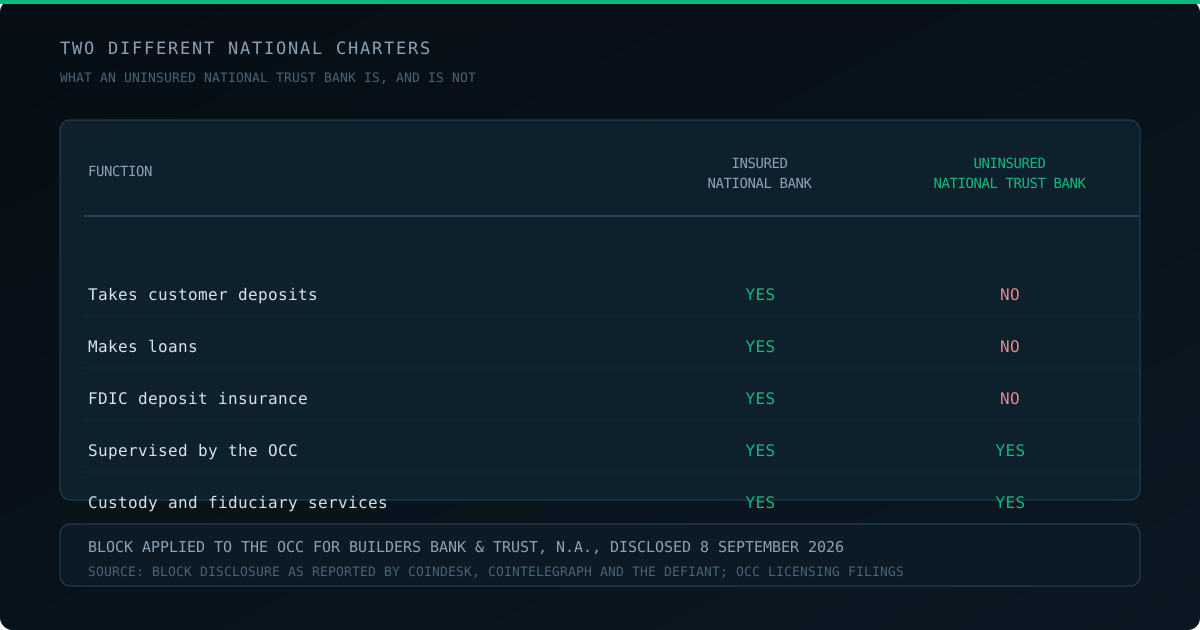
The appeal is supervisory, not promotional. US custody businesses are otherwise assembled from state money-transmitter licences, each with its own examiners and rules. A national charter replaces that patchwork with one federal framework, which large institutional clients tend to require before placing assets anywhere. The Defiant reported that the OCC's pending digital-asset licensing list held eleven applications received between 23 February and 19 August.
What a charter does not do is guarantee the assets. Federal deposit insurance protects deposits at a failed insured bank. It has never covered bitcoin, and it would not cover coins held in trust. Supervision raises the standard of record-keeping, segregation and examination. It does not make the holdings risk-free, and the application is under review with no stated timeline.
3. Today's Headlines
PayPal opens a platform for stablecoins backed by its stablecoin
PayPal launched PYUSDx, letting businesses issue branded tokens backed by PayPal USD. Infrastructure firm M0 built the platform and MoonPay manages the PYUSD reserves behind the issued tokens. A token backed by a stablecoin adds a layer: holders depend on the issuer, on PYUSD, and on the assets behind PYUSD.
Consensys splits MetaMask from its institutional business
Consensys said it will separate into two companies by the end of 2026. The existing company becomes MetaMask, a consumer business led by Joe Lubin, while a new Consensys under chief executive Mike Kriak takes the Linea network and institutional infrastructure.
Brent settles above $100 as Middle East attacks widen
Brent crude rose 3.36 percent to settle at $101.21 a barrel, its highest close since 22 May, after US Central Command said its forces destroyed five Iranian oil tankers and Houthi militants attacked Saudi energy facilities. Energy prices feed into inflation with a lag, which is how a conflict reaches rate expectations and then risk assets.
4. Security Note: check what "regulated" actually covers
Custody marketing leans on words that sound like guarantees. A charter, a licence and an audit each cover something specific, and none promises to make you whole if assets are lost. Before trusting a custodian, ask three questions and expect documents rather than assurances: are client assets legally segregated from the company's own, who is the named supervisor, and what insurance exists, against which risks, with what limit. A firm that names a regulator without describing what it covers is marketing.
5. From the Academy Library
Our guide to cold storage and hardware wallets covers the alternative to trusting a custodian at all. For how institutions split key control, read multi-party computation wallets, or start at Academy School.
Bottom line: A trust charter changes who examines the custodian, not who carries the risk. That distinction is the whole story of Block's application.
Sources and further reading
- Binance: BTC daily closing prices
- Binance: ETH daily closing prices
- Alternative.me: Crypto Fear and Greed Index history
- U.Today: spot bitcoin ETF daily flows for 8 and 9 September
- The Defiant: Block seeks an OCC charter for an uninsured custody bank
- Cointelegraph: Block seeks a US trust bank charter
- CoinDesk: PayPal launches PYUSDx
- The Block: Consensys splits MetaMask from its institutional business
- CNN Business: Brent crude settles above $100
Disclaimer: This publication is for education and information only. It is not financial, investment, legal, tax, or security advice.