
Crypto Lexicon
Impermanent Loss
Impermanent Loss is the difference in value between holding tokens in your personal private wallet versus depositing them into an Automated Market Maker (AMM) liquidity pool when the relative price of the paired tokens diverges.
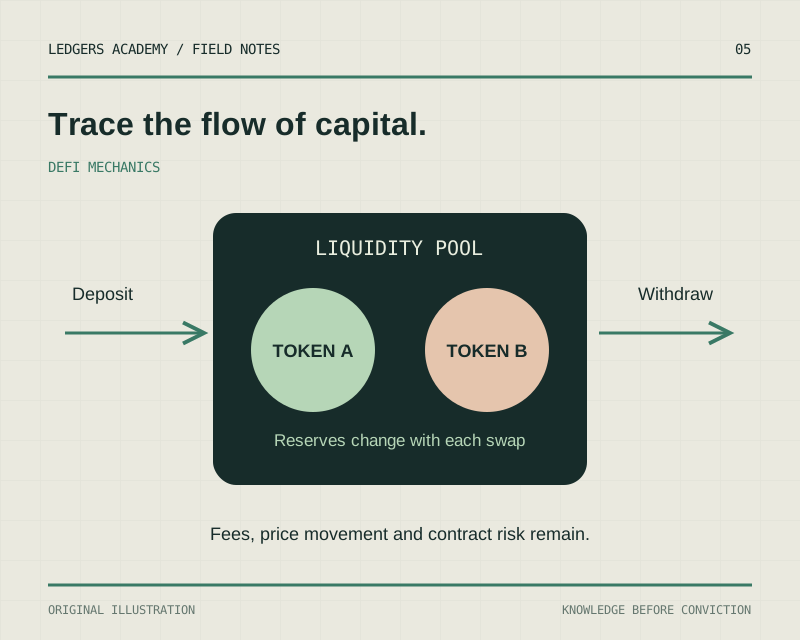
How Impermanent Loss Happens
Decentralized exchanges like Uniswap and Raydium use liquidity pools where depositors provide an equal dollar value of two assets (such as SOL and USDC).
- The Constant Product Formula: The pool maintains a mathematical balance using the formula where token A multiplied by token B equals constant product K.
- Price Divergence: When the external market price of token A surges, arbitrage bots buy cheap token A from the pool and deposit token B until pool prices match external markets.
- The Net Result: Liquidity providers end up with less of the appreciating asset and more of the lagging asset compared to simply holding both tokens in cold storage.
Why is it Called Impermanent?
The loss is considered impermanent because if the relative prices of the two tokens return to the exact ratio they had when you entered the pool, the loss completely disappears.
However, if you withdraw your liquidity while prices remain diverged, the loss becomes permanent.
How to Mitigate Impermanent Loss
- Provide Liquidity for Correlated Pairs: Staking paired stablecoins (such as USDC and USDT) or liquid staking pairs (such as SOL and JitoSOL) carries near zero divergence risk.
- High Trading Fee Yields: Ensure the trading fee yield generated by the pool exceeds the calculated divergence loss.
Master decentralized trading protocols in our Complete Guide to Decentralized Finance (DeFi).
Knowledge check
Three quick questions on this entry. Pick an answer to see whether it is right.
Question 1 of 3Which description matches Impermanent Loss?
Question 2 of 3Which part of the lexicon does Impermanent Loss sit in?
Question 3 of 3Which of these also belongs to DeFi & Token Mechanics?