
Ledgers Academy Letter
The Quiet Ledger: Issue #6 | 18 September 2026
Senate market structure legislation failed its procedural vote, and within 48 hours the SEC opened a five-year window for tokenized stock trading and the CFTC took passive software out of the registration net. Rules made this way arrive faster and can be withdrawn just as fast.
Subject: The week Congress stopped and the agencies started
Preview: Market structure legislation died in the Senate on Tuesday. By Thursday the SEC had opened a five-year window for tokenized stock trading and the CFTC had taken passive software out of the registration net.
THE QUIET LEDGER
Issue #6 | Saturday 13 September to Friday 18 September 2026
The Senate refused to debate crypto market structure, two federal agencies moved without it, and the market treated the legislative failure as noise by squeezing shorts back above $80,000
Reporting window Saturday 13 September to Friday 18 September 2026. Data cutoff at the close of Friday 18 September. Friday was a completed US trading session, so this week's ETF figures are final rather than pending.
For most of this year the assumption was that American crypto rules would arrive as legislation. This week that assumption broke. The Digital Asset Market Clarity Act failed its procedural vote on Tuesday, and within 48 hours the Securities and Exchange Commission and the Commodity Futures Trading Commission had each used powers they already hold to do smaller versions of what the bill was meant to do. The market fell hard on Tuesday, then spent Thursday and Friday deciding it had overreacted. What changed is not the rules. It is who writes them, and how easily they can be unwritten.
1. The Macro Pulse
- Bitcoin: $80,874 at Friday's close, up about 4.8 percent on the week, after closing as low as $75,590 on Tuesday as the Senate vote landed.
- Ether: $2,612 at Friday's close, up about 3.9 percent on the week, after a Tuesday low of $2,398.
- Fear and Greed: 56, exactly where it sat the previous Friday after falling to 50 on Thursday. A flat weekly reading hides a full round trip.
- US spot bitcoin ETFs: five completed sessions ran from $160.0 million in on Monday to $450.3 million and $296.0 million out on Tuesday and Wednesday, then $159.5 million and $433.0 million back in. The week netted roughly $6 million, which is to say nothing at all.
- Federal funds target range: 3.75 to 4 percent after Wednesday's unanimous increase, the first since 2023. The statement's reasoning was brief: "Inflation remains elevated."
- Bank of Japan policy rate: 1.25 percent after Friday's increase on a 7 to 2 vote, the highest since 1995.
- Brent crude: $102.41 at Friday's settlement, down from $108.75 on Tuesday as Saudi Arabia restored damaged East-West pipeline capacity faster than expected.
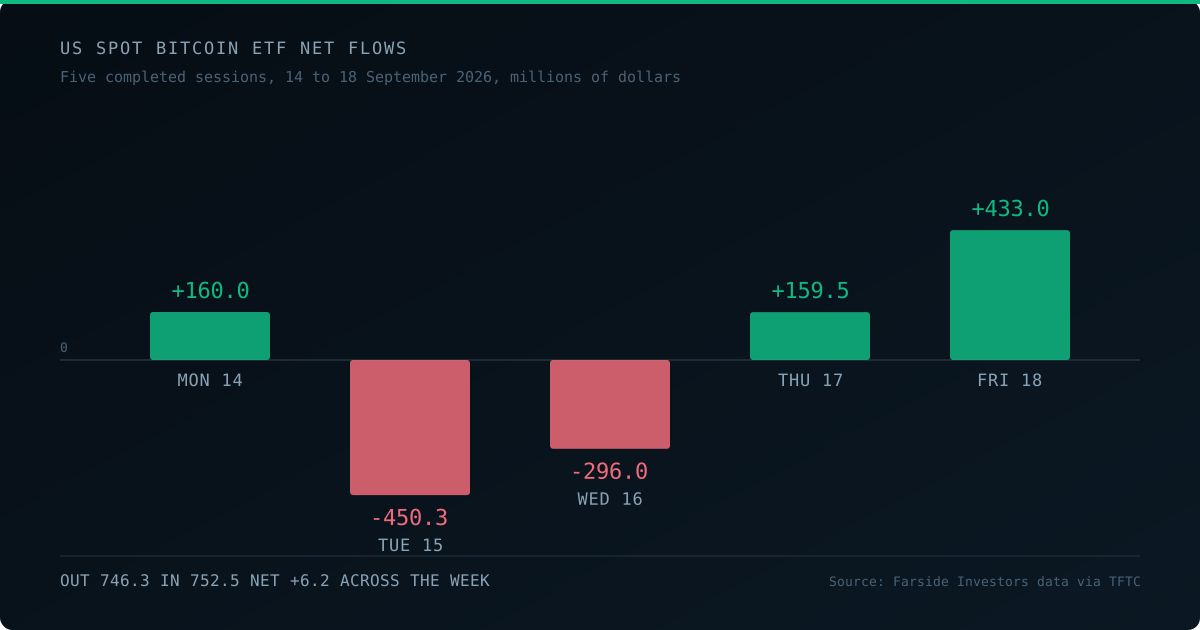
Takeaway: two central banks tightened in one week and bitcoin still posted its strongest session on Friday. That is not evidence that rates stopped mattering. It is evidence that the week's selling came from positioning around a political event, and positioning unwinds faster than policy does.
2. This Week in Headlines
Policy: the legislative route closed
The CLARITY Act failed its cloture vote on Tuesday 15 September. The motion to proceed needed 60 votes and did not get them. Published tallies disagree on the split, with CNBC and CoinDesk reporting 50 to 49 and others 49 to 50, but a chamber divided down the middle is nowhere near a supermajority. Reporting attributes the collapse to ethics language covering officials' crypto holdings rather than to the market structure text itself, and it is widely read as the end of Senate work on this for 2026.
A strategic bitcoin reserve bill cleared a House committee on Wednesday 16 September. H.R. 8957 was reported favourably by 28 votes to 21 on party lines, the first such bill to get that far. It would hold federally held bitcoin at the Treasury for 20 years and authorises no purchases. Congressional pages would not open for us this week, so that rests on secondary reporting.
Regulators: the administrative route opened
The SEC issued an "innovation exemption" for tokenized stock trading on Thursday 17 September. Conditional relief lets Tokenized Securities Venues trade tokenized National Market System stock through automated market makers without registering as exchanges. It runs five years and covers secondary trading only. It is the week's most consequential change, and our deep dive is below.
The CFTC moved twice on Thursday. Staff Letter 26-25 says its Market Participants Division will not recommend enforcement against providers of software that merely helps users trade with registered firms and venues. A no-action position is not a rule and binds no one permanently, but it lifts a live registration threat from developers. The same week the agency sent market structure rules to the White House: the reginfo.gov record shows "Regulation Crypto Asset Transactions and Regulation Crypto Asset Markets" received on 17 September at the prerule stage, contents confidential during review. It intends to proceed without new legislation.
Markets: a positioning story, not a conviction story
Friday's rally was mostly forced. Bitcoin ran from roughly $76,400 to $81,000 on liquidations of short positions. Counts differ by provider and window, from about $192 million to $514 million over 24 hours, but agree that shorts took close to 90 percent of the damage. Friday was also a quarterly expiry, and bitcoin dominance slipped under 59 percent to a one-month low as capital rotated outward.
Outside the United States
In Korea, KRW1 is being integrated into Rain's payment infrastructure. The won-backed token, issued by BDACS on Avalanche against deposits at Woori Bank, can now sit behind cards usable at Visa-accepting merchants. The token is not new. The distribution is, and it puts a non-dollar stablecoin on ordinary payment rails.
3. The Weekly Deep Dive: how a tokenized stock automated market maker pool actually works
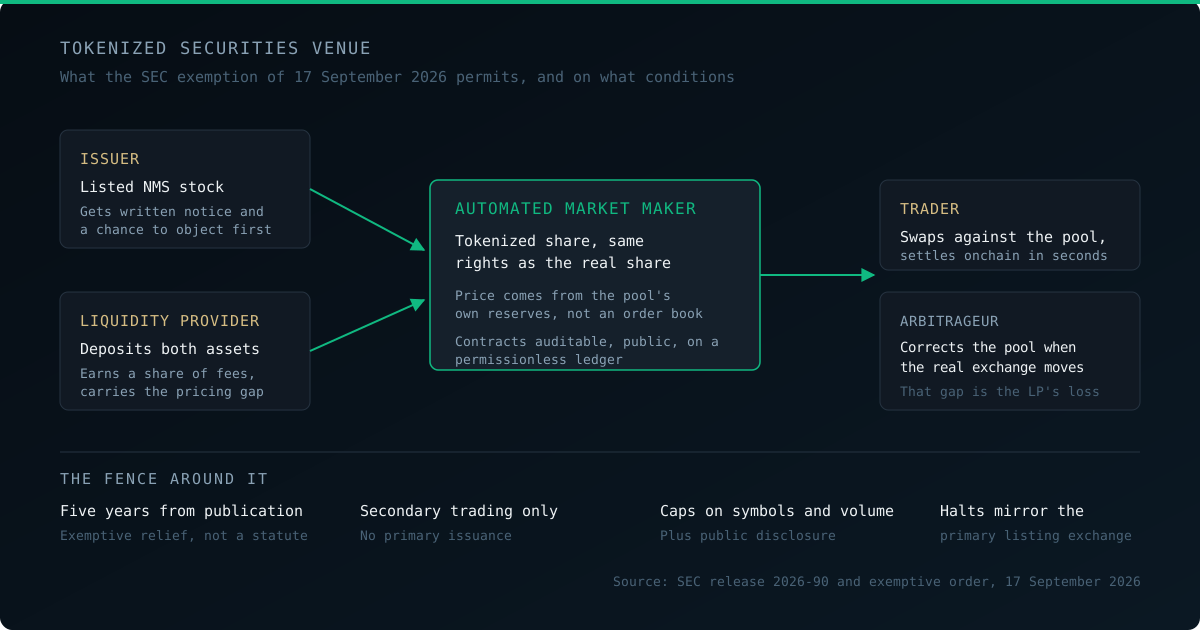
Start with the two halves of the phrase. A tokenized stock is a token on a blockchain representing a share in a company listed on a US exchange. Under this exemption it is not a derivative or a tracker: the SEC requires that the token "provides holders the same rights" as the ordinary share. An automated market maker pool is a smart contract holding two assets that quotes a price from a formula based on its own reserves, rather than matching buyers to sellers in an order book. Anyone can trade against it, and permitted liquidity providers deposit assets into it and earn a share of fees.
Put the halves together and a share trades continuously against a pool of cash-like tokens, settling on a public ledger in seconds, with nobody matching the two sides. That is the appeal. The SEC allows it for five years, for secondary trading only, under conditions that show what the regulator is worried about.
The conditions are the interesting part. Smart contracts "must be auditable, public, and deployed on a public, permissionless distributed ledger", so pricing logic cannot be a private black box. An issuer gets written notice and a chance to object before someone tokenizes its shares, which answers whether a third party can mint a claim on your company without asking. Trading halts must match the primary listing exchange, so a stock frozen for news cannot keep trading onchain at a stale price. Venues face caps on symbols and volume. This is a sandbox with a fence and a timer.
The failure modes follow from the design. A pool prices from its own reserves, so when the primary exchange moves, the pool is stale until an arbitrageur corrects it, and that gap is the liquidity provider's loss. Liquidity split between a tokenized venue and the ordinary market can leave both thinner. Custody sits underneath: the token is worth the share only if the entity holding that share stays solvent and redemption works under stress, which is untested at size.
The deepest limit is legal rather than technical. This is exemptive relief granted by a commission, not a statute passed by Congress. It can be narrowed, allowed to lapse, or challenged in court, and the jurisdictional question the CLARITY Act was meant to settle stays open. Anyone building on it is building on a permission slip: more than the industry had on Monday, much less than a law.
4. Security and Onchain Radar
On Tuesday 15 September an attacker removed about 2,900 rsETH, worth roughly $7.8 million at the time, from a Gnosis Safe multisig wallet. Safe's core contracts were not at fault. The owner had authorised a Multicall helper, a convenience contract that bundles several actions into one transaction, and its authorization check approved any caller who named the helper itself as the target. Four security firms, BlockSec, Blockaid, SlowMist and AstraSec, traced the failure there.
Then the theft went sideways. The attacker's transaction sat in the public mempool, the waiting area where pending transactions are visible before confirmation, and an automated bot spotted it, paid roughly $47,000 in priority fees to be ordered first, and ran the same drain into its own address. The bot took 2,882 rsETH and the attacker got almost nothing. Kelp DAO, which issues rsETH, paused the affected address for 24 hours and confirmed the token stayed fully collateralised. Who keeps the money is unresolved.
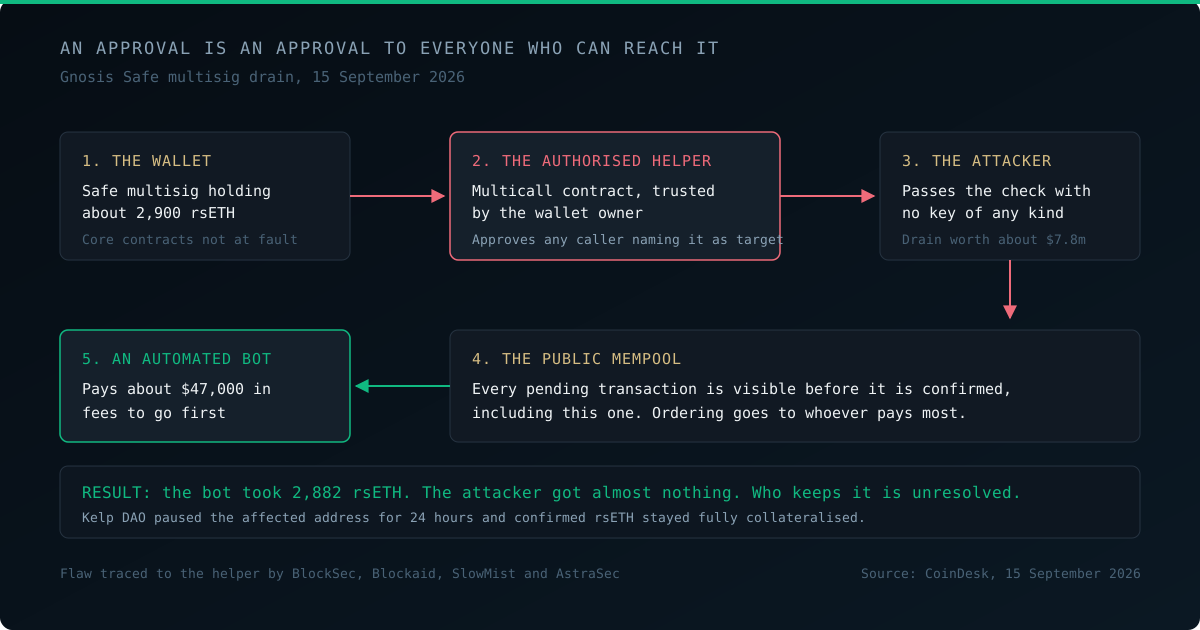
The rule to take from this: an approval granted to a contract is an approval granted to everyone who can reach that contract. Audit the modules and approvals attached to a shared wallet on a schedule rather than once at setup, and treat every helper, router or batching contract as part of your security perimeter, because it is.
5. From the Academy Library
The mempool mechanics behind that rescue are explained in our entry on maximum extractable value, and because the drained asset was a restaking token, restaking and how it layers risk belongs beside it. Our guide to geopolitics, US policy and sovereign crypto reserves covers why jurisdiction is contested, and Tuesday's Daily Ledger on the cloture vote has the procedural detail. New readers should start at Academy School.
Two tools worth knowing, neither affiliated with us: the reginfo.gov dashboard, which shows what an agency has sent to the White House, and Etherscan's approval checker, which lists the contracts your address trusts.
Bottom line: a bill needs 60 senators. An exemption needs three or four commissioners. The industry spent this week learning which number it can actually reach, and rules made that way arrive faster, cover less, and can be withdrawn by the people who granted them.
Disclaimer: This publication is for education and information only. It is not financial, investment, legal, tax, or security advice.
Sources and further reading
Policy and regulation
- CNBC: Senate cloture vote on the CLARITY Act fails
- CoinDesk: CLARITY Act flames out in failed Senate vote
- National Law Review: Senate fails to advance the CLARITY Act
- SEC: innovation exemption for tokenized NMS stock, release 2026-90
- SEC: the exemptive order itself
- CFTC: no-action position for passive software providers, Staff Letter 26-25
- reginfo.gov: CFTC crypto asset rulemaking under White House review
- crypto.news: reserve bill clears the House panel 28 to 21
Macro and markets
- Federal Reserve: FOMC statement, 16 September 2026
- Federal Reserve: summary of economic projections
- Bank of Japan: monetary policy decision, 18 September 2026
- CNBC: Brent settles lower as Saudi pipeline capacity returns
- The Block: bitcoin reclaims $80,000 as the market shrugs off the CLARITY setback
- TFTC: daily US spot bitcoin ETF flows, aggregating Farside Investors data
- CoinDesk: bitcoin dominance slips as capital rotates to altcoins