
Ledgers Academy Letter
The Quiet Ledger: Issue #5 | 11 September 2026
Petrol pushed US consumer prices to 3.4 percent over the year while the core measure held at 2.4. Ether gained about 7 percent on bitcoin, Nasdaq backed tokenized equities with voting rights, and Liquid's white hats turned out to want a ransom.
Subject: The week headline inflation and core inflation stopped agreeing
Preview: Petrol pushed US consumer prices to 3.4 percent while the core measure held at 2.4. Ether gained 7 percent on bitcoin, and Liquid's white hats turned out to want a ransom.
THE QUIET LEDGER
Issue #5 | Saturday 5 September to Friday 11 September 2026
An energy shock lifted headline inflation while the core measure stayed contained, ether pulled sharply away from bitcoin, and the Liquid Network incident ended the week as an extortion case
Data cutoff 15:00 UTC on 11 September 2026 (17:00 Europe/Stockholm). Friday's US trading session was still open at that time, so Friday ETF flows are pending rather than zero.
Two inflation prints landed four days apart, and they told different stories about the same economy. Producer prices on Thursday and consumer prices on Friday were both pushed up by fuel, yet once energy is stripped out the underlying rate barely moved. Markets spent most of the week trading the headline and then, on Friday, repriced around the core. The clearest expression of that shift was not in bitcoin at all: ether gained about 7 percent against it over the week. Meanwhile the security story that opened the week closed it in a different genre entirely.
1. The Macro Pulse
- Bitcoin: $78,846 at 15:00 UTC on 11 September, down about 1.0 percent from Saturday's open of $79,661. It traded as low as $76,569 at Thursday's close before Friday's recovery.
- Ether: $2,608, up about 6.2 percent on the week from $2,456, and up 6.8 percent over the trailing 24 hours alone.
- Ether against bitcoin: 0.0331, up from 0.0308 last Friday, a gain of roughly 7 percent.
- Fear and Greed: 56, down 18 points from 74 last Friday, despite the Friday rally.
- US spot bitcoin ETFs: net outflows of $46.6 million on 8 September and $100.7 million on 9 September, the last completed sessions before the cutoff. The week to 4 September had recorded $986.9 million of inflows, so the direction turned rather than collapsed.
- US consumer prices: up 0.4 percent in August and 3.4 percent over twelve months. Excluding food and energy, up 0.3 percent and 2.4 percent.
- Brent crude: $101.21 at Wednesday's settlement, up 3.36 percent and its first close above $100 since July.
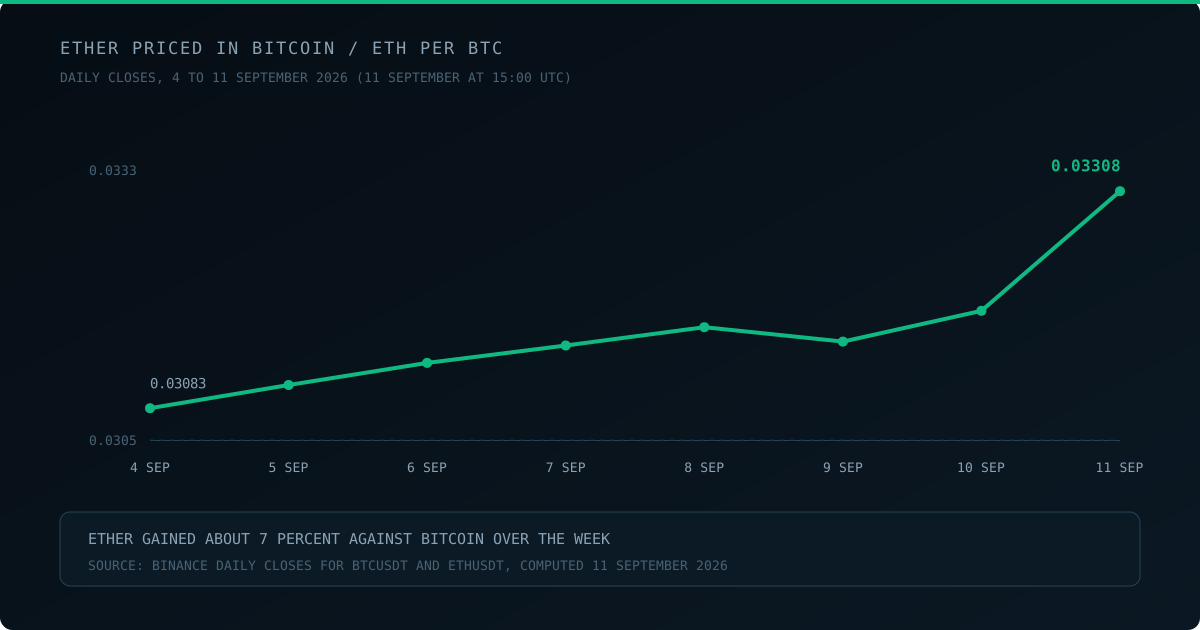
The takeaway is the divergence itself. Price and sentiment moved apart: the Fear and Greed index fell through the week even as ether rallied hard, which usually means positioning was cut before the data rather than after it. Treat the Friday move as a reaction to a single release, not as confirmation of a trend.
2. This Week in Headlines
Policy and law
ESMA devoted a section of its Trends, Risks and Vulnerabilities report to prediction markets, saying that marketing event contracts in the EU generally requires authorisation that the largest platforms do not hold. It questioned why Polymarket and Kalshi block some member states but not others, and whether geographic restrictions survive a VPN. Where such contracts are financial instruments they are derivatives, which brings them under existing binary-option bans for retail investors.
Poland remains the only EU member state without a national framework implementing MiCA after the Sejm failed a third attempt on 4 September to override the presidential veto, falling 25 votes short of the three-fifths threshold. Firms there face EU obligations with no domestic authority to license them.
Institutions and market structure
Nasdaq is investing $100 million in Payward, Kraken's parent, to build tokenized equities that are stated to carry shareholder voting rights equivalent to ordinary shares, with a launch targeted for the second quarter of 2027. Block separately disclosed an application to the OCC for Builders Bank & Trust, an uninsured national trust bank that would hold bitcoin and stablecoins without taking deposits or lending.
PayPal launched PYUSDx, letting businesses issue branded tokens backed by PayPal USD, with MoonPay managing the reserves. Visa said its stablecoin settlement passed a $20 billion annualised run rate, more than fifteen times a year earlier. An annualised run rate projects current activity forward; it is not money already settled this year.
International
India's market regulator began a Demat 2.0 pilot carrying more than $100 million in tokenized bonds, and Germany's Bundesbank became the first institution to run Matter Labs' newly open-sourced Prividium permissioning engine in its own infrastructure. Both are settlement infrastructure experiments by institutions that rarely move quickly, which is the point worth noting.
Protocols
Harmony published a non-binding proposal to shut down its Layer 1 and reissue ONE as an ERC-20 on Ethereum. Wallet balances, staking delegations and exchange balances would carry across a final snapshot; multisignature safes, liquidity pools and on-chain applications would not. Holders were urged to exit those positions before 10 September.
3. The Weekly Deep Dive: what is the difference between headline and core inflation?
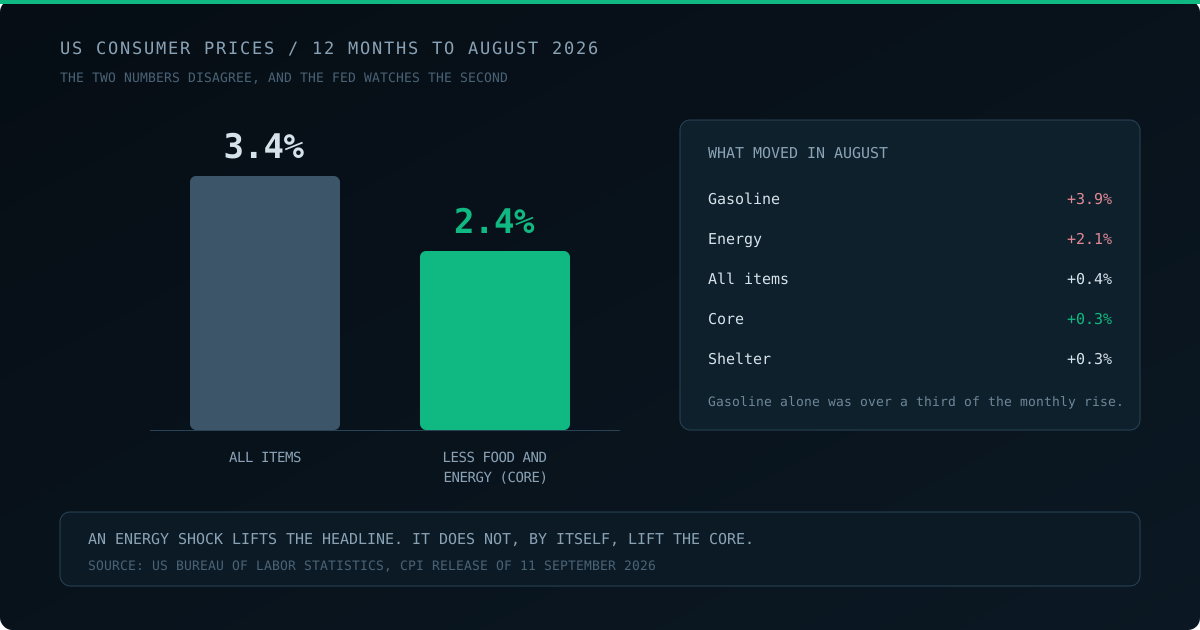
Headline inflation is the change in the whole basket of goods and services a household buys. Core inflation is the same basket with food and energy removed. The exclusion sounds arbitrary, and to a household it is: nobody gets to stop buying petrol because a statistician set it aside. The reason central banks watch the core measure anyway is not that fuel does not matter. It is that fuel prices are set largely outside the domestic economy, they swing violently in both directions, and interest rates cannot do anything about them.
That is exactly what August looked like. The Bureau of Labor Statistics reported that all items rose 0.4 percent in the month and 3.4 percent over the year, with petrol up 3.9 percent and accounting for more than a third of the monthly increase on its own. Strip food and energy out and the rise was 0.3 percent in the month and 2.4 percent over the year. Thursday's producer price release told the same story from the seller's side: 5.4 percent over the year, with diesel up 24.1 percent in August alone.
The reason it mattered this week is that the energy move has an identifiable cause. Brent settled above $100 on Wednesday after attacks on tankers and on Saudi energy facilities. A supply shock of that kind raises the headline number for as long as it lasts and then drops out of the annual comparison twelve months later. A central bank that tightened policy in response would be raising the price of domestic credit to address the price of foreign oil.
The practical consequence for crypto runs through rate expectations. Earlier in the week the CME FedWatch tool showed above 60 percent implied odds of an increase at the 15 and 16 September meeting, and risk assets sold off accordingly. A core reading of 2.4 percent cuts against that case, which is the most plausible explanation for Friday's rebound.
The limits are worth stating plainly. Core is not a forecast, and sustained energy costs do eventually feed into it through transport and production. Implied odds are a market price, not a prediction, and they move daily. One month is not a trend, and a reader who takes a single print as confirmation of anything has substituted a number for an argument. The useful habit is simply to check which measure a headline is quoting before deciding what it means.
4. Security and Onchain Radar
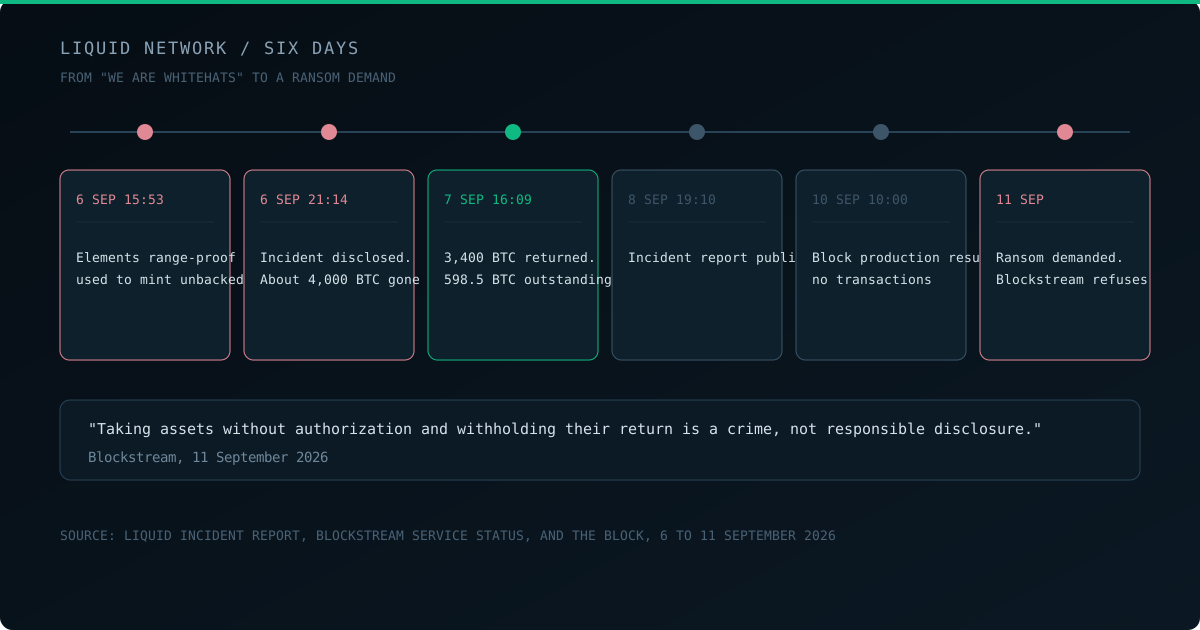
The week's defining security story changed category twice. On 6 September roughly 4,000 BTC left the Liquid federation wallet after a caching flaw in Elements range-proof verification let attackers create L-BTC that nothing backed, which they then redeemed through an authorised peg-out path. No key was stolen. An on-chain message claimed the actors were white hats, and on 7 September they returned 3,400 BTC.
Then it became something else. The group demanded a 10 percent bounty for the remaining 598.5 BTC. Blockstream refused, telling them to "return the bitcoin" and adding that "taking assets without authorization and withholding their return is a crime, not responsible disclosure." The firm said it would pursue exchanges, forensic specialists and law enforcement instead.
Separately, Trezor confirmed a breach at its external email provider that let attackers send phishing from its own legitimate domain, under the subject "Critical Security Alert: STM32 Entropy Vulnerability". BitBox reported a similar campaign the same day.
Two rules follow. First, a self-declared white hat is a claim, not a category: until funds are returned unconditionally, treat an incident as theft and size your exposure accordingly. Second, a genuine sender address proves nothing once a vendor's mail provider is compromised. Never act on a security email by clicking its link. Open the vendor's site yourself, and never enter a recovery phrase anywhere but the device.
5. From the Academy Library
For the rotation running underneath the week, our bitcoin market cycles and macro guide covers how rate expectations transmit into crypto, and the dollar index and its correlation with bitcoin explains the channel. The incidents above now sit in our 2026 crypto exploit tracker with their causes and recovery status. New readers can start at Academy School.
Bottom line: an energy shock can raise the price level without changing the thing a central bank is trying to control. This week the market read the first number, then the second. The gap between them is where next week's meeting will be decided.
Sources and further reading
- Bureau of Labor Statistics: Consumer Price Index, August 2026
- Bureau of Labor Statistics: Producer Price Index, August 2026
- Federal Reserve: 2026 FOMC meeting calendar
- Binance: BTC daily closes
- Binance: ETH daily closes
- Alternative.me: Crypto Fear and Greed Index history
- U.Today: spot bitcoin ETF flows for 8 and 9 September
- CNN Business: Brent crude settles above $100
- The Block: ESMA on prediction market authorisation
- Crypto.news: Poland's third failed veto override
- Nasdaq: deepening its relationship with Payward
- The Defiant: Block's OCC trust charter application
- CoinDesk: PayPal launches PYUSDx
- The Block: Visa stablecoin settlement run rate
- Ledger Insights: Bundesbank tests Prividium
- Blockonomi: Harmony's shutdown proposal
- Blockonomi: Blockstream refuses the Liquid ransom demand
- Blockstream: Liquid security incident status page
- The Block: Trezor phishing from its legitimate domain
- The Motley Fool: CME FedWatch rate expectations on 8 September
Disclaimer: This publication is for education and information only. It is not financial, investment, legal, tax, or security advice.