
Ledgers Academy Letter
The Daily Ledger: 6 September 2026
The IMF says every bitcoin added to El Salvador's official holdings since June 2025 came from private donations, not public funds, as a US$140 million tranche advances. The Liquid sidechain pauses after a $320 million peg-out.
Subject: The IMF says El Salvador's bitcoin came from donations
Preview: A $140 million tranche advances, the Liquid sidechain pauses after a $320 million peg-out, and Pakistan's licensing deadline passes.
THE DAILY LEDGER
6 September 2026
An IMF review settles who paid for El Salvador's bitcoin, a Bitcoin sidechain halts, and Pakistan's first licensing deadline arrives
Editor's note: market data reflects the 23:59 UTC daily close on 6 September 2026 (01:59 Europe/Stockholm on 7 September). News was checked to 23:00 UTC.
The IMF said every bitcoin added to El Salvador's official holdings since June 2025 came from private donations, not public funds. That finding cleared the way for a staff-level agreement worth about US$140 million. Elsewhere the day was less settled: a Bitcoin sidechain paused after roughly $320 million left its reserve wallet.
1. The Day in Numbers
- Bitcoin: $80,342 at the 23:59 UTC close, up 0.6 percent over 24 hours.
- Ether: $2,514 at the 23:59 UTC close, up 1.4 percent over 24 hours.
- Fear and Greed Index: 73, Greed, unchanged from Saturday.
- US spot bitcoin ETFs: $986.9 million of net inflows for the week ended 4 September, a third consecutive positive week. That is a completed weekly total, not a running figure.
A weekend close carries less information than a weekday one, because regulated venues are shut and volumes thin out.
2. Did El Salvador buy bitcoin with public money?
According to the IMF, no, not since June 2025. CoinDesk reported that documents reviewed by the Fund showed the additions came from private donations. The Fund named no donors and quantified no contributions, so the finding covers the source of the coins, not who provided them.
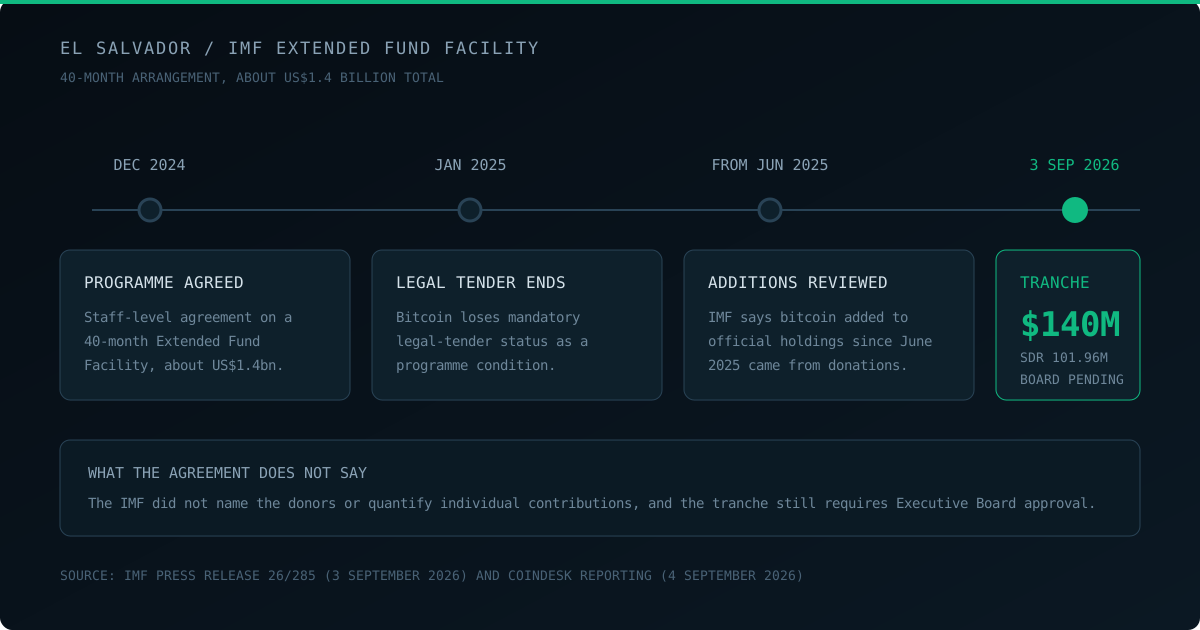
El Salvador is inside a 40-month Extended Fund Facility, a lending arrangement that releases money in tranches only after IMF staff verify agreed commitments. One commitment, agreed in January 2025, removed bitcoin's status as mandatory legal tender. On 3 September the Fund agreed at staff level on the combined second and third reviews, worth about US$140 million, or SDR 101.96 million.
Two things remain open. The tranche still needs Executive Board approval, so it is agreed rather than paid, and majority control of the Chivo wallet has moved to a private operator the IMF did not identify. Holding bitcoin and spending tax revenue on bitcoin are different policies. This review settles only the second.
3. Today's Headlines
Liquid Network pauses after about 4,000 BTC leaves its reserve
The Block reported that Liquid, a Bitcoin sidechain run by a federation of companies, disclosed late on 6 September that roughly 4,000 BTC had left its federation wallet. An on-chain message claimed the actors were white hats. Blockstream said the peg-out authorization key used was not compromised, and disabled bridge nodes. The cause was not yet explained.
Pakistan's first licensing deadline passes
Firms providing virtual asset services in Pakistan on or before 5 March 2026 had until 5 September to apply for a no-objection certificate from the new Pakistan Virtual Assets Regulatory Authority. That certificate is a step toward a licence, not a licence. Operating without an application is now an offence under the Virtual Assets Act 2026.
Russia's digital-asset framework takes effect
Russia's framework for regulated crypto activity came into force on 1 September. Non-qualified investors must pass a knowledge test and face an annual purchase limit of 300,000 roubles per intermediary. Paying for goods in crypto inside Russia remains illegal.
4. Security Note: a wrapped coin is a claim, not the coin
A token representing bitcoin on another network is a claim against whoever holds the real bitcoin. If that holder is a federation, a bridge contract, or a custodian, your risk includes them. Before holding one, answer three questions: who holds the reserve, does it publish proof of reserves, and what happens if the bridge is paused. If you cannot answer all three, keep the position small enough that a freeze is survivable.
5. From the Academy Library
Our guide to geopolitics, US policy and sovereign crypto reserves explains why states hold bitcoin and how lenders respond. For wrapped-asset mechanics, read cross-chain bridges, or start at Academy School.
Bottom line: El Salvador's bitcoin question was an accounting question, and the accounting has now been reviewed. Liquid is the opposite case: the numbers are known and the explanation is not.
Sources and further reading
- Binance: BTC daily closing prices
- Binance: ETH daily closing prices
- Alternative.me: Crypto Fear and Greed Index history
- The Block: spot bitcoin ETF weekly inflows
- IMF: staff-level agreement on El Salvador's combined second and third reviews
- CoinDesk: IMF on El Salvador's bitcoin additions
- The Block: Liquid Network pauses after peg-out
- Blockstream: Liquid security incident status page
- Pakistan Virtual Assets Regulatory Authority
- Dawn: Pakistan's 5 September certificate deadline
- Crypto.news: Russia's framework and Sberbank's lending plans
Disclaimer: This publication is for education and information only. It is not financial, investment, legal, tax, or security advice.