
Ledgers Academy Letter
The Daily Ledger: 27 September 2026
Bitget's User Protection Fund covers this week's $351.6 million loss at today's prices. Reporting puts it at around 5,500 bitcoin, so on 1 August, when bitcoin traded at $62,820, the same coins were worth less than the loss. A fund held in the asset it insures shrinks when it is needed.
Subject: Bitget's protection fund is mostly bitcoin, which is the problem with it
Preview: The fund covers this week's loss at $84,000. On 1 August, when bitcoin was $62,820, the same coins would not have covered it. A fund held in the asset it insures shrinks exactly when it is needed.
THE DAILY LEDGER
27 September 2026
A closer look at the user protection fund covering this week's exchange loss, a quiet Sunday for prices, and the withdrawal queue that opens tomorrow morning
Editor's note: prices are CoinGecko 00:00 UTC snapshots for 27 September 2026, checked again at 10:30 UTC (12:30 Europe/Stockholm). No fund flow or liquidation data is produced over a weekend. Fund composition figures below come from reporting rather than an audited disclosure.
Bitget says the roughly $351.6 million it lost on Thursday falls inside a User Protection Fund holding more than $464 million, and at today's prices that is true. It is worth asking what the fund is made of. Reporting puts it at around 5,500 bitcoin, which means its dollar value moves with the asset it exists to insure, and on 1 August, when bitcoin traded at $62,820, those same coins were worth about $345 million: less than this week's loss.
1. The Day in Numbers
- Bitcoin: $84,417 at 00:00 UTC, up about 0.4 percent from Saturday's open.
- Ether: $2,696 at 00:00 UTC, effectively flat for a third day.
- Fear and Greed Index: 70, Greed, down four points from Saturday's 74.
- Bitcoin market value: $1.696 trillion at 00:00 UTC, with ether at $329 billion.
- Bitget withdrawals: still suspended, with bitcoin scheduled to reopen on Monday at 08:00 UTC. A published schedule is not a completed one.
2. Does a crypto exchange protection fund actually protect you
A user protection fund is money an exchange sets aside from its own resources to cover losses from a hack or a system failure. It is not deposit insurance. No regulator stands behind it, no statute defines what must be in it, and no rule stops the company spending it on something else tomorrow. It is a promise, and its value is whatever the assets inside it are worth on the day a claim arrives.
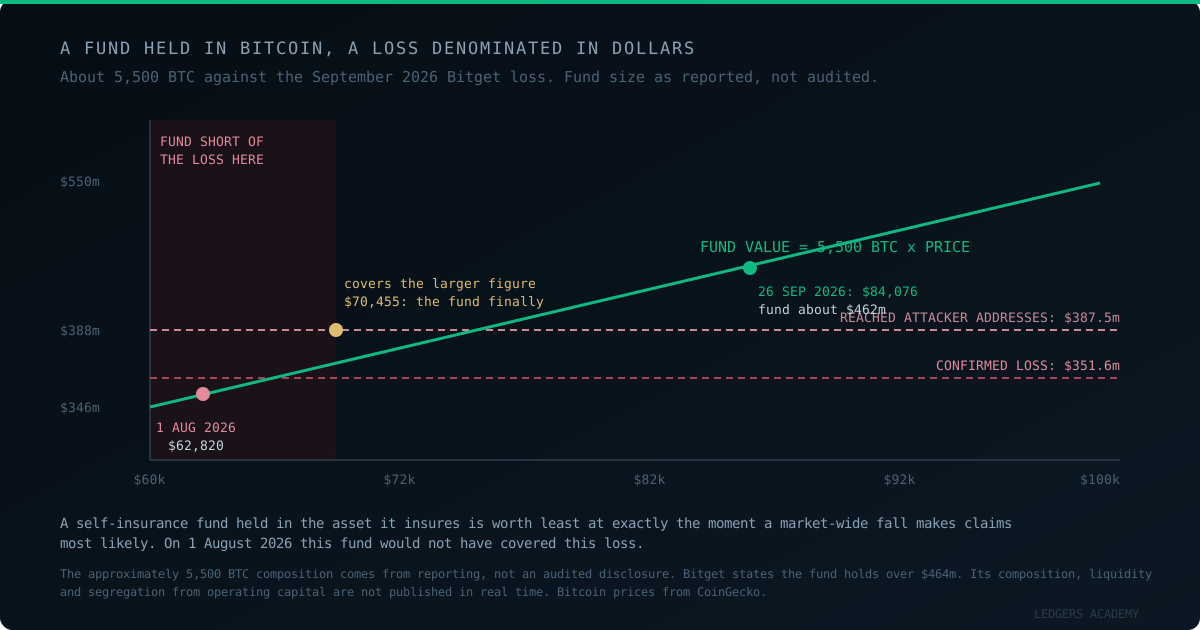
Holding that promise in bitcoin creates a specific weakness. The fund is worth most when the market is calm and expensive, and least when the market has fallen, which is exactly when an exchange is most likely to face a loss it cannot absorb from revenue. Insurers call this correlated collateral, and they avoid it on purpose. Here the collateral and the risk are the same asset.
There is a second problem, which is that nobody outside the company can check any of this in real time. The composition is not independently audited as it changes, there is no public evidence of legal segregation from operating capital, and a fund that is held in bitcoin cannot be spent on a loss without selling bitcoin into whatever market exists on the day. Bitget is scheduled to publish a proof of reserves snapshot this week, which addresses customer balances rather than the fund.
None of this says the fund will fail. It covered this loss. It says the cover is conditional on a price, and that the condition is never disclosed as a condition.
3. Today's Headlines
The withdrawal queue opens tomorrow
Bitcoin withdrawals are scheduled to reopen at 08:00 UTC on Monday, then ether and other tokens on Tuesday, USDT on Wednesday and the remainder on 2 October. The first few hours of real traffic will say more about customer confidence than any statement has.
A third flat session
Bitcoin has traded in a band of roughly $340 across three days while sentiment drifted from 74 to 70. Weekend volumes are thin and no completed flow data exists, so weekend moves carry less information than weekday ones.
No verified international development
Sunday produced no confirmed policy or market development outside the United States worth reporting. We would rather say that than pad the list.
4. Security Note
This is an evergreen note, labelled as such, because no new incident was documented in the last 24 hours. The lesson from the week is about the question you ask a custodian. Most people ask whether an exchange has been hacked. The more useful question is what happens afterwards, and that has three parts: what the fund holds, whether it is segregated, and who confirms both.
The rule: before you leave a balance on any exchange, find the page where it describes its protection fund and look for three specific things: the assets it holds, a statement that those assets are legally separated from operating money, and the name of whoever verifies it. If any of the three is missing, treat the balance as uninsured, because it is. That is an argument for keeping only what you are actively using on a venue, and the rest in cold storage.
5. From the Academy Library
What happens when a custodian fails outright is in what happens when a crypto exchange goes bankrupt, reserve snapshots are in proof of reserves, and the running incident list is on the crypto exploit tracker. New readers can start at Academy School.
A fund that covers a loss at $84,000 and misses it at $62,820 is not a safety net. It is a bet that nothing goes wrong in a bear market.
Disclaimer: This publication is for education and information only. It is not financial, investment, legal, tax, or security advice.
Sources and further reading
- Memeburn: the Bitget hack and the bitcoin-backed protection fund
- TokenPost: the loss could consume roughly three quarters of the protection fund
- CoinDesk: Bitget loses $352 million and says user funds are safe
- Bitget: withdrawals to resume in phases
- CoinGecko: bitcoin price on 1 August 2026, used in the chart above
- Alternative.me: Fear and Greed Index