
Ledgers Academy Letter
The Daily Ledger: 23 September 2026
BitMEX stopped trading at 04:00 UTC after 11 years, solvent and with withdrawals still open. A voluntary wind-down works in the opposite direction from a bankruptcy: nothing is frozen and nobody joins a queue, but balances left behind start accruing a fee.
Subject: The exchange that invented the perpetual swap closed its doors at 04:00 UTC
Preview: BitMEX shut down after 11 years, solvent and with withdrawals still open. That is a very different situation from an exchange that fails, and the deadline is the part that costs people money.
THE DAILY LEDGER
23 September 2026
BitMEX ends an 11 year run, Europe's markets regulator makes digital innovation a supervisory priority, and bitcoin holds near an eight month high
Editor's note: prices and sentiment were checked at 07:10 UTC on 23 September 2026 (09:10 Europe/Stockholm). Figures quoted at 00:00 UTC are CoinGecko daily snapshots.
BitMEX stopped trading at 04:00 UTC this morning, 11 years after it introduced the perpetual swap that now dominates crypto derivatives. The company is solvent and withdrawals are still open, which is what happens to your money when a crypto exchange shuts down on purpose rather than collapsing: nothing is frozen, nobody is in a queue, and the real risk is a deadline you forget about.
1. The Day in Numbers
- Bitcoin: $86,183 at 00:00 UTC, roughly flat against Tuesday's open and still near its highest level since January.
- Ether: $2,753 at 00:00 UTC, down about 0.8 percent on the same basis.
- Fear and Greed Index: 71, Greed, down seven points from Tuesday's 78, which was the only Extreme Greed reading of this run.
- Bitcoin market value: $1.731 trillion at 00:00 UTC, with ether at $336 billion.
2. What happens to your money when a crypto exchange shuts down
A wind-down and a failure look similar from the outside and work in opposite directions. BitMEX gave notice on 23 July that it would close two months later, and this morning it ended trading, deposits and new positions while leaving withdrawals running. The operator, HDR Global Trading Limited, says the decision followed a strategic review of the business.
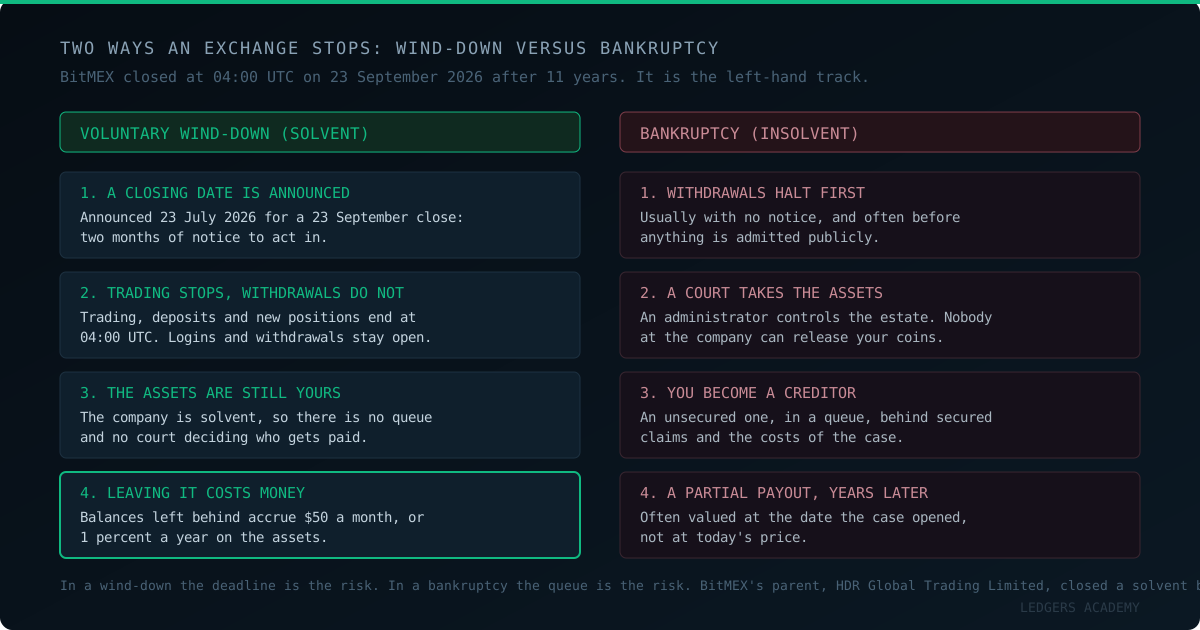
In a solvent wind-down the coins remain customer property and the company can still release them, so the only thing standing between a user and their balance is attention. BitMEX has said balances left behind will be charged a maintenance fee of $50 a month or 1 percent a year on the assets. That is the quiet cost: an abandoned account does not get frozen, it gets slowly billed.
A bankruptcy inverts all of it. Withdrawals stop first, a court takes the estate, and the customer becomes an unsecured creditor in a queue. Our note on what happens when a crypto exchange goes bankrupt covers that path. What is still unknown here is where BitMEX's insurance fund ends up, and whether the perpetual swap volume it once held simply moves to venues with thinner disclosure.
3. Today's Headlines
ESMA makes digital innovation a supervisory priority
The European Securities and Markets Authority announced a new Union Strategic Supervisory Priority on digital innovation, starting in 2027 and focused first on how supervised firms use artificial intelligence and tokenisation. ESMA names four concerns: supervisory readiness, fairness of automated outputs, investor understanding of new products, and over-reliance on a small number of third-party providers.
The SEC's crypto offering rule is still open for comment
The Commission's proposed Regulation Crypto Assets, published on 18 August, would create two exemption tiers for token sales, $5 million over four years and $75 million per 12 months, plus a conditional safe harbour that stops treating an asset as an investment contract once the issuer has finished or abandoned the managerial work it promised. Comments run for 60 days after Federal Register publication.
Sentiment cools without the price following
Bitcoin held near $86,000 while the Fear and Greed Index gave back seven points. A sentiment index is a survey of mood built from volatility, volume, social media and dominance, not a measure of flows, so it can fall on a flat day.
4. Security Note
An exchange closure is a gift to phishing crews, and this is the pattern to expect rather than a confirmed incident: messages claiming to be the closing exchange, warning that a balance is about to be forfeited, and linking to a cloned withdrawal page. The real notice never needs your seed phrase, and a genuine wind-down gives weeks of notice, not hours.
The rule: when an exchange you use announces a closing date, withdraw on the day you read the news, not on the deadline. Reach the site by typing the address yourself, move funds to a wallet you control rather than another custodian you have not used, and expect the volume of fake warnings to rise as the date approaches. Our cold storage guide covers where the balance should land.
5. From the Academy Library
Perpetual swaps, the instrument BitMEX introduced, are explained through funding rates, the payment that keeps a perpetual tethered to spot. Counterparty risk and venue choice sit in the complete beginner guide to crypto trading, and new readers can start at Academy School.
BitMEX closed the way an exchange should close: slowly, loudly, and with the door still open on the way out. Most of the ones people remember did not.
Disclaimer: This publication is for education and information only. It is not financial, investment, legal, tax, or security advice.
Sources and further reading
- CoinDesk: BitMEX shuts down trading after 11 years and leaves withdrawals open
- CoinDesk: BitMEX notifies users it is ending operations by 23 September
- ESMA: new supervisory priority on digital innovation from 2027
- SEC: Commission proposes new Regulation Crypto Assets
- CoinGecko: daily price and market value snapshots used above
- Alternative.me: Fear and Greed Index