
Ledgers Academy Letter
The Daily Ledger: 22 September 2026
Bitcoin opened Tuesday about 6.7 percent higher at roughly $86,597, its best level since January, after more than $1 billion of crypto positions were closed by force on Monday, about $878 million of them short bets. Closing a short means buying.
Subject: Bitcoin's 6.7 percent day was bought by people who did not want to buy
Preview: More than a billion dollars of positions were closed by force on Monday, most of them bets on a lower price. Here is why that mechanically lifts the price.
THE DAILY LEDGER
22 September 2026
A short squeeze carries bitcoin to its highest level since January, the European Central Bank puts central bank money on a distributed ledger, and CME sets a launch date for two more crypto futures
Editor's note: prices, sentiment and market data were checked at 14:55 UTC on 22 September 2026 (16:55 Europe/Stockholm). Liquidation and open interest readings are rolling 24 hour figures, not completed daily totals.
Bitcoin opened Tuesday at about $86,597, roughly 6.7 percent above Monday and its highest since January. No policy decision or announced purchase explains it. Forced buying does, which is how short liquidations push the bitcoin price up: a bet on a falling price runs out of collateral, and the exchange closes it by buying.
1. The Day in Numbers
- Bitcoin: $86,021 at 14:51 UTC, down 0.02 percent over a rolling 24 hours, a window starting after Monday's move.
- Ether: $2,735 at 14:51 UTC, down 0.59 percent, after opening Tuesday about 5 percent higher.
- Fear and Greed Index: 78, Extreme Greed, up eight points from 70 on Monday and the first Extreme Greed reading in this run.
- Total crypto market value: $2.92 trillion, down 2.31 percent, bitcoin dominance 58.9 percent and ether 11.4 percent.
- Crypto liquidations: above $1 billion over the 24 hours around Monday, roughly $878 million of it shorts, per CoinGlass figures cited in reporting. A rolling reading, not a completed total.
2. How short liquidations push the bitcoin price up
A short position is a borrowed bet that a price will fall, held against collateral. When the price rises instead, that collateral covers a growing loss, and at some threshold the exchange closes the position for you. Closing a short means buying the asset back, at whatever it costs.
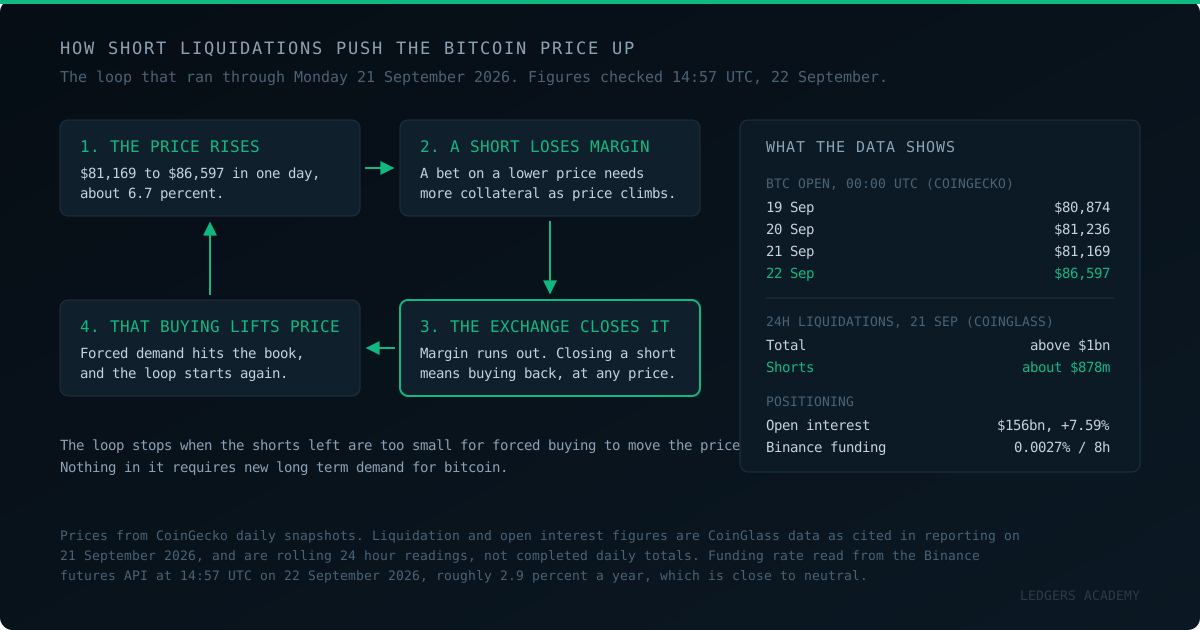
Across thousands of accounts that becomes a loop, each forced buy pushing the next tier of shorts past its threshold. CoinDesk reported that by Monday morning in Europe shorts were 86.8 percent of the 24 hour liquidation total and about 95 percent of the previous hour's, so the forced buying was speeding up. Open interest, the value of open futures contracts, rose 7.59 percent to about $156 billion.
What a squeeze cannot tell you is whether anyone wants to own bitcoin at $86,000, because the buying was involuntary. Binance perpetual funding sat at 0.0027 percent per eight hours on Tuesday afternoon, close to neutral, so no obviously crowded long side has been left behind.
3. Today's Headlines
The European Central Bank switches on Pontes
The Eurosystem launched Pontes on 21 September, linking market distributed ledger platforms to the ECB's settlement systems so tokenised securities can settle against central bank money rather than a commercial bank deposit. Thirteen banks including Deutsche Bank, Santander and the European Investment Bank are onboarded, with four ledger operators, and full functionality is due by 2028. This is not the digital euro and is not open to the public.
CME dates Bitcoin Cash and Uniswap futures
CME Group said on Tuesday it will list Bitcoin Cash and Uniswap futures on 19 October, pending regulatory review, in standard and micro sizes, alongside its bitcoin, ether, XRP and Solana contracts.
Circle lets institutions borrow dollars against bitcoin
Circle opened Digital Asset-Backed Borrowing to eligible Circle Mint customers on 21 September. A client deposits BTC, mints a wrapped token called cirBTC, posts it as collateral on an approved lending market and receives USDC.
Two treasury buyers filed before the move
Strategy's 8-K on 21 September reported 950 BTC bought for $75.7 million, an average of $79,670, taking it to 846,000 BTC. Strive reported 1,355 BTC near $79,475. Both filings cover the week to 18 September, before the squeeze.
4. Security Note
No new major exploit was reliably documented in the last 24 hours, so this is an ongoing campaign, not a fresh one. The Internal Revenue Service has a standing fraud alert about counterfeit IRS letters posted to crypto holders, carrying a QR code and a deadline for enrolling in a "Digital Asset Compliance Portal". No such portal exists, and some recipients then get a call from someone posing as an IRS officer.
The rule: never scan a QR code printed in a letter claiming to be from a tax authority, and never type a seed phrase or exchange password into a site you reached that way. Type the agency's address yourself. Paper feels more official than email, which is why this works. Our note on token approvals and drainers covers what one signature can hand over.
5. From the Academy Library
Leverage, margin and forced closes are covered in the complete beginner guide to crypto trading. Funding rates sit in our lexicon entry, and what happens when a liquidation finds no counterparty is in auto-deleveraging. New readers can start at Academy School.
A squeeze is a real price and a real transfer of money. It is also a crowd being closed out by machines, which says nothing about demand.
Disclaimer: This publication is for education and information only. It is not financial, investment, legal, tax, or security advice.
Sources and further reading
- CoinDesk: short squeeze drives bitcoin toward $85,000 as $648 million of shorts are liquidated
- CoinGlass: cryptocurrency liquidation data
- European Central Bank: Eurosystem brings central bank money to tokenised finance
- CME Group: expanding the crypto derivatives suite with Bitcoin Cash and Uniswap futures
- Circle: Digital Asset-Backed Borrowing product terms
- SEC EDGAR: Strategy Inc Form 8-K, 21 September 2026
- SEC EDGAR: Strive Inc Form 8-K, 21 September 2026
- IRS Criminal Investigation: fake IRS letters target cryptocurrency holders
- CoinGecko: global market data used for the figures above
- Alternative.me: Fear and Greed Index