
Ledgers Academy Letter
The Daily Ledger: 20 September 2026
Seven agencies from Japan, the United States, Australia and Germany published the scale of North Korea's fake recruiter campaign: 30,000 devices, more than 7,000 crypto wallets and at least $10.71 million, all reached through a coding test. Plus a flat ETF week, Polygon's permissionless burn and Binance's first foreign exchange perpetual.
Subject: Seven agencies just put a number on the fake job interview
Preview: 30,000 machines, 7,000 wallets and $10.71 million, all from developers who were asked to run one file. The advisory is public and the fix is unglamorous.
THE DAILY LEDGER
20 September 2026
Seven agencies publish the scale of North Korea's fake recruiter campaign, bitcoin drifts below $81,000 on a quiet weekend, and Polygon prepares a burn anyone can trigger
Editor's note: prices, sentiment and market data were checked at 02:50 UTC on 20 September 2026 (04:50 Europe/Stockholm). Sunday is not a trading session, so the last completed week for fund flows ended Friday 18 September.
On 18 September the police and intelligence agencies of four countries put their names to one document about fake job interview crypto malware, and for once the numbers are precise. A North Korean group known as WaterPlum infected at least 30,000 devices in more than 100 countries and took funds or credentials from over 7,000 cryptocurrency wallets. Every one of those victims did the same thing: they ran a file a recruiter sent them.
1. The Day in Numbers
- Bitcoin: $80,569 at 02:50 UTC, down 0.88 percent over the trailing 24 hours. That window rolls continuously and is not a completed daily change.
- Ether: $2,593 at 02:50 UTC, down 1.05 percent over the trailing 24 hours.
- Fear and Greed Index: 71, Greed, unchanged from Saturday and up from 56 on Friday.
- Total crypto market value: $2.75 trillion, with bitcoin dominance back up to 58.9 percent from 58.3 percent a day earlier.
- US spot bitcoin ETFs: net inflows of $6.2 million across the whole week to Friday 18 September, a flat week rescued by Friday's $433 million. Spot ether funds lost $140 million over the same week and ended a four week run of inflows.
2. How a fake job interview turns into a drained crypto wallet
The advisory carries seven signatures, from Japan, the United States, Australia and Germany, and covers December 2025 to July 2026.
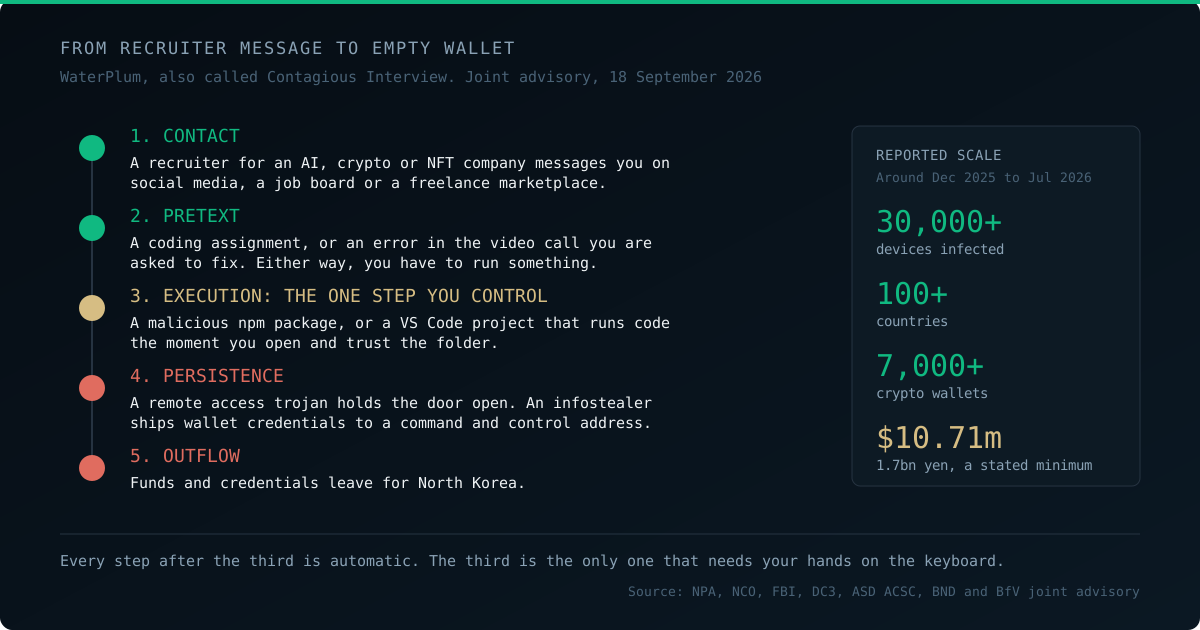
The pretext is a technical interview or a coding test. The payload arrives as a Node Package Manager package, the standard way JavaScript developers install other people's code, or as a Visual Studio Code project. The agencies name five malware families, including BeaverTail and StoatWaffle. One of them exploits a detail worth knowing: opening a folder in VS Code and answering yes to "do you trust the authors" can run a configuration file automatically, before you have read a line of code.
After that it is out of your hands. A remote access trojan keeps the connection alive, an infostealer sends wallet credentials to an address the attackers control, and the assets move. The $10.71 million figure is a stated minimum, not a complete tally.
3. Today's Headlines
Polygon prepares a burn that anyone can set off
Polygon Foundation chief executive Sandeep Nailwal said on 18 September that a permissionless burn contract is live on testnet, waiting on Security Council signatures. The first call would destroy 100 million POL, about 83 percent of the 121 million in the network's fee collector and slightly under one percent of total supply, with quarterly burns open to anyone afterwards.
Binance opens a foreign exchange desk that never closes
Binance lists its first foreign exchange perpetual contract on Monday 21 September, US dollar against the Brazilian real, settled in tether at up to 100 times leverage. Currency markets shut at weekends, so the contract switches from a third party index to its own order book on Saturdays and Sundays. Bybit listed euro, sterling and yen versions less than two weeks earlier.
Hyperliquid turns collateral into a loan you ask for
Hyperliquid opened manual borrows on 18 September: supply HYPE or bitcoin, borrow dollar stablecoins against it at a 65 percent loan-to-value ratio for HYPE and 50 percent for bitcoin. Roughly $269 million was borrowed on the first day.
4. Security Note
Two rules come straight out of the advisory, and both are free. First, never open an unknown repository in an editor that can run code on launch. In Visual Studio Code, answer "No" to the trust prompt, which is Restricted Mode, then read .vscode/tasks.json before you change your mind. Code you did not write belongs in a virtual machine, not on the machine holding your keys.
Second, if a device is ever infected, treat the wallet as gone even if the balance is not. The rule: generate a new wallet on a different, clean device, move everything to it, keep the new seed phrase offline, then wipe the old machine. Removing malware does not un-send what it already took, and a seed phrase that touched a compromised computer is public information from then on. Our cold storage guide covers doing that properly.
5. From the Academy Library
The contracts behind Binance's currency listing are explained in our entry on funding rates and perpetual futures, and Custody Without Slogans takes on the awkward question of which device your keys should live on. New readers can start at Academy School.
Nothing in this campaign broke any cryptography. Seven thousand wallets opened because seven thousand people were polite to a recruiter.
Disclaimer: This publication is for education and information only. It is not financial, investment, legal, tax, or security advice.
Sources and further reading
- Joint advisory, 18 September 2026: North Korean "WaterPlum," commonly referred to as "Contagious Interview" (PDF)
- National Police Agency of Japan: alert on North Korean IT workers
- The Block: bitcoin ETFs end the week up $6.2 million as ether funds snap a four week streak
- Crypto Briefing: Polygon prepares a permissionless burn of 100 million POL
- Cointelegraph: Binance expands into foreign exchange with 24/7 perpetuals
- Hyperliquid documentation: manual borrows, collateral ratios and liquidation thresholds
- CoinGecko: global market data used for the figures above
- Alternative.me: Fear and Greed Index