
Ledgers Academy Letter
The Daily Ledger: 19 September 2026
The CFTC sent crypto market structure rules to the White House review office on 17 September, the first real step toward regulating the market without Congress. The text stays confidential, and a binding rule is roughly a year away.
Subject: The CFTC just sent its crypto rules somewhere you cannot read them
Preview: A filing at the White House review office is the first real step toward crypto market structure rules without Congress. It is also invisible, non-binding, and about a year from mattering.
THE DAILY LEDGER
19 September 2026
The CFTC sends crypto market structure rules to the White House for review, bitcoin holds above $81,000 after Friday's short squeeze, and an institutional technology provider loses client data through read-only keys
Editor's note: prices, sentiment and market data were checked at 12:12 UTC on 19 September 2026 (14:12 Europe/Stockholm). Saturday is not a US trading session, so Friday 18 September is the last completed session and its ETF figures are final.
Four days after the Senate refused to debate crypto market structure, the Commodity Futures Trading Commission sent its own version to the White House. The filing is dated 17 September on the public review docket. Whatever emerges is roughly a year away, and nobody outside the agencies can read a word of it yet.
1. The Day in Numbers
- Bitcoin: $81,312 at 12:12 UTC, up 4.31 percent over the trailing 24 hours. That window rolls continuously and is not a completed daily change.
- Ether: $2,640 at 12:12 UTC, up 5.53 percent over the trailing 24 hours.
- Fear and Greed Index: 71, Greed, up from 56 on Friday and 50 on Thursday.
- Total crypto market value: $2.80 trillion, with bitcoin dominance at 58.3 percent, near a one-month low as money rotated into other assets.
- US spot bitcoin ETFs: net inflows of $433.0 million on Friday 18 September, the last completed session and a second straight day of inflows, with $310.7 million of it into Fidelity's FBTC.
2. What happens when an agency files a rule at OIRA?
A US agency cannot simply publish a rule. A significant one first goes to the Office of Information and Regulatory Affairs, a review office inside the White House. The docket shows "Regulation Crypto Asset Transactions and Regulation Crypto Asset Markets" received on 17 September, at the stage labelled prerule.
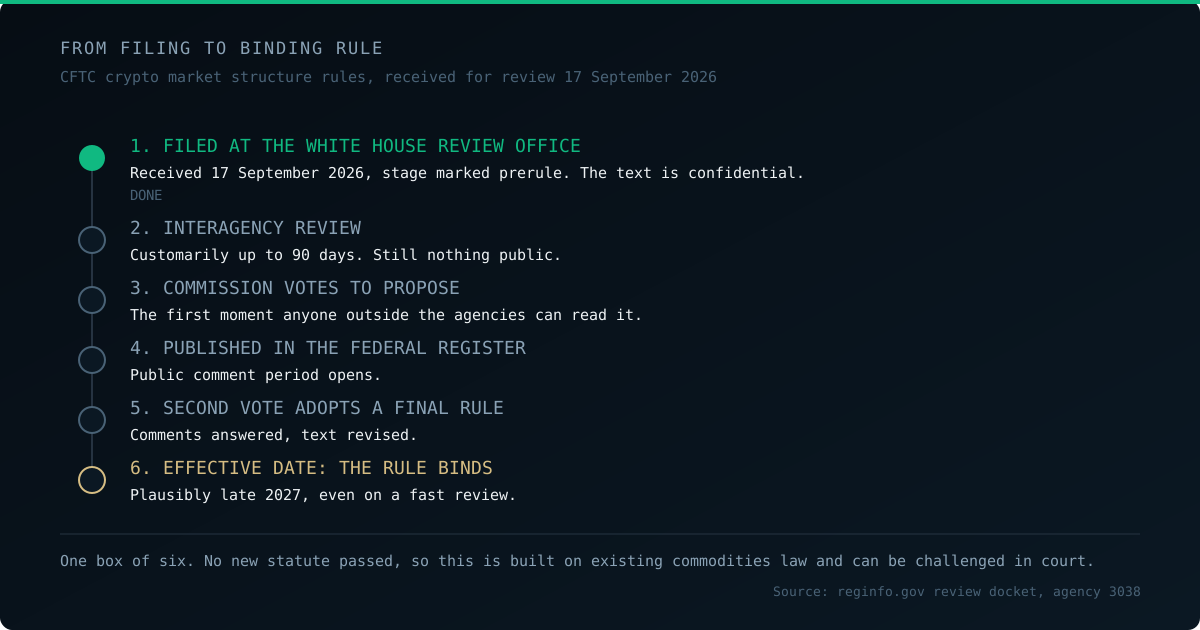
Prerule means nothing has been proposed publicly yet. Review customarily runs up to 90 days. If the draft survives it, the Commission votes to propose the rule, it is published in the Federal Register, the public comments, and the Commission votes again to adopt a final version. Even on a fast review that means a binding rule in late 2027.
Two things matter. The contents stay confidential during review, so anyone describing what these rules say is guessing. And with the CLARITY Act dead, the agency is stretching authority it already holds under existing commodities law, which is precisely the ground for a court challenge.
3. Today's Headlines
The Bank of Japan raised rates to a 31-year high
On Friday the Bank of Japan lifted its policy rate from 1.00 to 1.25 percent on a 7 to 2 vote, the highest since 1995. Two central banks tightened inside 48 hours and crypto rose anyway, which says more about positioning than about monetary policy.
Friday's move was a short squeeze
Bitcoin's run past $80,000 came with roughly $514 million of liquidations in 24 hours, about $458 million of them short positions, on CoinGlass data reported Friday. It was also a quarterly expiry. Forced buying explains much of the move.
BitMEX closes for good on Wednesday
The derivatives exchange that helped make perpetual futures standard shuts permanently at 04:00 UTC on 23 September, as announced in July. If you still hold a balance there, this is the week it stops being your decision.
4. Security Note
Haruko, which supplies trading technology to institutional crypto clients, was breached this week. CoinDesk, which reviewed client communications, reports 15 clients affected: every client that had not restricted access to a list of approved network addresses. Attackers extracted a user access token and read data from a running process's memory, and some smaller hedge fund clients lost assets. There is no public statement from the company, so this rests on reporting rather than disclosure.
The stolen exchange keys were read-only, and read-only keys are widely treated as harmless because they cannot move funds. They still expose positions, sizes and timing, which is enough to trade against you or to write a convincing phishing message. The rule: put an address allowlist on every exchange API key, read-only ones included, and rotate any key a vendor holds on a schedule you control.
5. From the Academy Library
Our guide to crypto tax and regulation sets out why SEC and CFTC jurisdiction is contested, and yesterday's Quiet Ledger covers the SEC exemption from the same week. New readers can start at Academy School.
A filing is not a rule, and a rule is not a law. The industry has one more of the first and none of the last.
Disclaimer: This publication is for education and information only. It is not financial, investment, legal, tax, or security advice.
Sources and further reading
- reginfo.gov: CFTC rules under White House review, received 17 September 2026
- CoinDesk: CFTC sends crypto rules to the White House as Congress stalls
- Bank of Japan: monetary policy decision, 18 September 2026
- The Japan Times: the Bank of Japan raises its policy rate to 1.25 percent
- CoinDesk: bitcoin dominance slips as focus switches to altcoins
- CoinDesk: Haruko hit by a cyberattack affecting 15 clients
- BitMEX: closure notice and key dates
- CoinGecko: global market data used for the figures above