
Ledgers Academy Letter
The Daily Ledger: 15 September 2026
The CLARITY Act failed its Senate cloture vote 49 to 50 against a 60-vote threshold, with four Republicans crossing over. Crypto had its worst session since June, spot bitcoin funds shed $450.4 million, and two Robinhood engineers were charged over trades placed before listings.
Subject: The CLARITY Act died 11 votes short of a debate
Preview: Cloture failed 49 to 50 when four Republicans crossed over, and crypto had its worst session since June.
THE DAILY LEDGER
15 September 2026
The Senate refuses to open debate on the crypto market structure bill, spot bitcoin funds see their largest redemption day of the month, and two Robinhood engineers are charged over trades placed before listings
Editor's note: this issue uses the completed daily candle for 15 September 2026, 00:00 to 23:59 UTC, from Binance. Prices are closes for that session rather than an intraday snapshot.
The CLARITY Act failed its cloture vote in the Senate on Tuesday afternoon, 49 votes to 50, against a threshold of 60. That is not a narrow loss. It is short of a simple majority, and it came after sponsors accepted more than 120 Democratic changes. Crypto had its worst session since June.
1. The Day in Numbers
- Bitcoin: $75,644 at the 15 September close, down 3.3 percent on the session, with a low of $74,968.
- Ether: $2,398 at the close, down 4.7 percent, a heavier fall than bitcoin.
- Fear and Greed Index: 69, Greed. The index is built from trailing data and had not yet caught up with the session, a reminder that it lags rather than leads.
- US spot bitcoin ETFs: $450.4 million of net redemptions, the largest single day in September, per Farside Investors. Fidelity's fund lost $214.8 million and BlackRock's $161.7 million.
- Ten-year Treasury yield: 5.00 percent, up from 4.97 percent, with an intraday high above 5.04 percent.
2. What is a cloture vote, and why did the CLARITY Act need 60 votes?
Cloture is the Senate's procedure for ending debate. Without it a bill can be talked to death, so nothing controversial moves unless 60 senators agree. Tuesday's vote was not on the CLARITY Act itself. It was on whether the Senate would begin debating it at all.
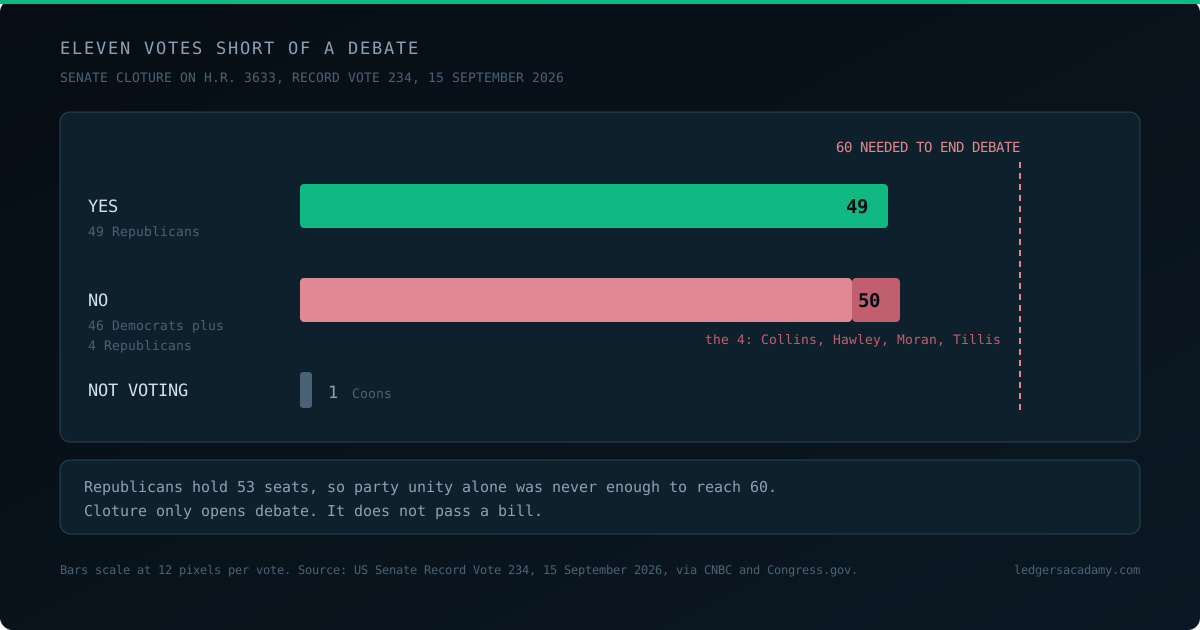
The arithmetic explains the outcome. Republicans hold 53 seats, so even perfect unity left them seven short and dependent on Democrats. Instead four Republicans voted no, Susan Collins, Josh Hawley, Jerry Moran and Thom Tillis, cutting the yes column to 49. Chris Coons did not vote. Senator Cynthia Lummis said before the vote that "we've given them over 120 of their requests."
What died is a statutory division of labour between the Securities and Exchange Commission and the Commodity Futures Trading Commission. What did not die is either agency's existing authority. The SEC's proposed Regulation Crypto Assets is still out for comment and enforcement continues under current law. The boundary simply stays where regulators and courts put it, case by case, rather than being written down by Congress. CNBC called it a regulatory setback. Prediction markets cut the odds of enactment this year from about 29 percent to about 7 percent.
3. Today's Headlines
Two Robinhood engineers charged over pre-listing trades
Federal prosecutors in the Southern District of New York charged Hefu Chai and Huaisong Xiang with commodities and wire fraud. Both had access to a private channel naming planned Robinhood Crypto listings, and both allegedly bought perpetual futures on Hyperliquid ahead of those announcements, profiting more than $50,000 each. Robinhood said it reported the matter itself.
Coinbase shares fall 10 percent
Coinbase closed down 10.1 percent at $172.11 as the result landed. Chief executive Brian Armstrong called it a disappointment while noting that the SEC and CFTC already hold authority over the sector.
A restaking wallet loses $7.7 million, and a bot takes it
A Safe wallet holding restaked ether was drained of about $7.73 million through a custom Uniswap v4 module with a public entry point and no access check. A trading bot then front-ran the attacker and took the proceeds. Kelp said its own contracts were not at fault.
4. Security Note: an orderly shutdown is still a deadline
CoinEx announced on 15 September that it is closing after nine years, citing weak volumes and rising compliance costs. It says reserves exceed 100 percent of customer balances, and the wind-down is staged: non-spot services end on 22 September, spot trading stops on 29 September with remaining assets converted to a dollar stablecoin, and withdrawals close on 22 December. That last date is the one to act on. A solvent, well-run closure still ends with a deadline after which your coins are someone else's problem, and a forced conversion means you may not exit in the asset you chose. If you hold a balance anywhere you no longer trade, move it now, not when the support queue is longest.
5. From the Academy Library
Our crypto tax and regulatory guide covers how the agency boundary works in practice, and proof of reserves explains what a reserve claim does and does not prove. For today's exploit, see restaking explained. Start at Academy School.
Bottom line: The vote did not reject a crypto framework on its merits. It refused to start the debate, which leaves the rules exactly where they were, written by regulators rather than legislators.
Sources and further reading
- Binance: BTC daily candles
- Binance: ETH daily candles
- Alternative.me: Crypto Fear and Greed Index history
- Crypto Daily: spot bitcoin ETF flows for 15 September, citing Farside Investors
- CNBC: Senate cloture vote on the Clarity Act fails
- CoinGape: live coverage of the cloture vote and reaction
- The Crypto Times: CLARITY Act falls short of 60 votes
- Bitcoin.com News: the concessions made before the vote
- CoinDesk: two Robinhood engineers charged over Hyperliquid trades
- CryptoSlate: details of the charges against the two engineers
- Crypto Daily: Safe wallet loses $7.73 million through a malicious v4 hook route
- The Crypto Times: CoinEx shutdown and the 22 December withdrawal deadline
Disclaimer: This publication is for education and information only. It is not financial, investment, legal, tax, or security advice.