
Ledgers Academy Letter
The Daily Ledger: 12 September 2026
Canada's banking regulator says a tokenized deposit is legally still a deposit. Symbiosis halts its bitcoin bridge after an unbacked mint, the CLARITY Act faces a Senate cloture vote on Tuesday, and Revolut handed customer passports and bitcoin histories to a fake government request.
Subject: Canada says a tokenized deposit is still a deposit
Preview: OSFI's technology-neutral statement, a Symbiosis bridge mint that was never backed, and Revolut's fake government data request.
THE DAILY LEDGER
12 September 2026
Canada rules that tokenized deposits are legally ordinary deposits, Symbiosis halts its bitcoin bridge after an unbacked mint, and Revolut hands customer passports to a fake government request
Editor's note: prices and sentiment were checked at 20:33 UTC on 12 September 2026 (22:33 Europe/Stockholm). Saturday has no US exchange session, so the ETF figures below are the completed totals for Friday 11 September.
Canada's Office of the Superintendent of Financial Institutions (OSFI) has answered a question banks have circled: what is a tokenized deposit, legally? Its statement of 10 September says it is a deposit, and the technology used to record it changes nothing. The weekend also brings a fresh bridge exploit and a Revolut data breach that passed every email check.
1. The Day in Numbers
- Bitcoin: $77,197 at 20:33 UTC, down 0.2 percent over the trailing 24 hours on Binance. That window rolls continuously and is not a completed daily change.
- Ether: $2,523 at 20:33 UTC, down 0.2 percent over the trailing 24 hours.
- Fear and Greed Index: 63, Greed, seven points above Friday's 56.
- US spot bitcoin ETFs: $13.3 million of net outflows on Friday 11 September, a fourth straight session, per SoSoValue. Trackers disagree on daily totals.
- US spot ether ETFs: $216 million of net inflows on the same Friday.
2. What is a tokenized deposit, and how is it different from a stablecoin?
A tokenized deposit is a bank deposit recorded as a token on a distributed ledger instead of in the bank's core ledger. The holder's claim is still against the bank. OSFI's statement puts it plainly: "The underlying technology of a financial product or service does not determine its legal nature," and "Tokenized deposits are, for example, not legally distinct from traditional deposits."
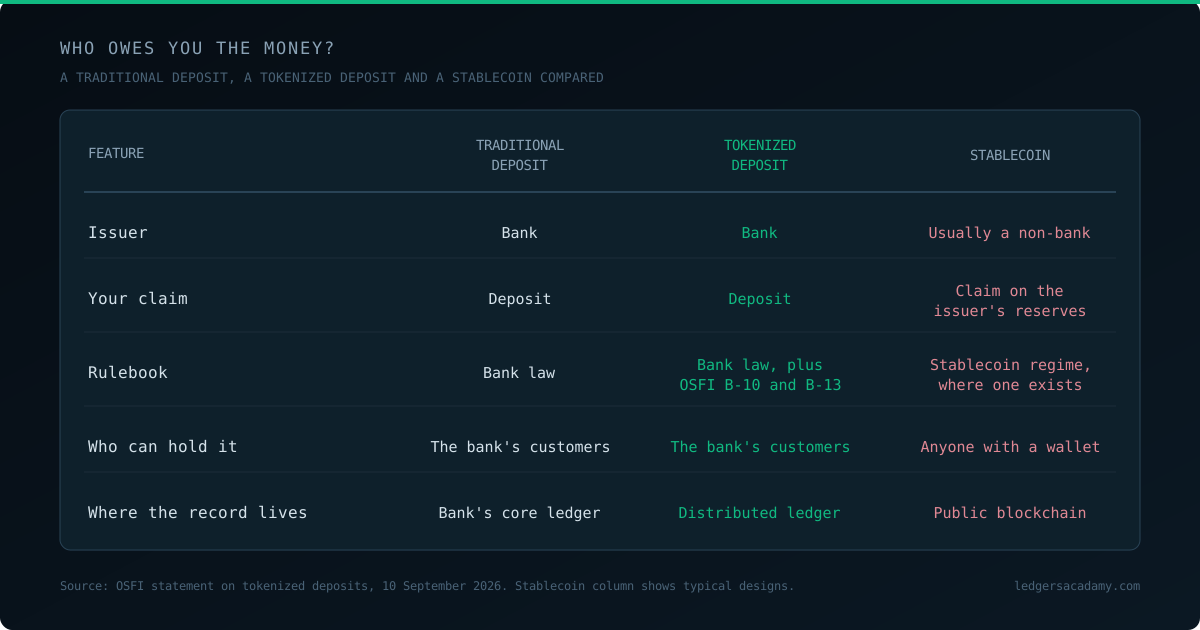
That is the distinction from a stablecoin, which is a claim on its issuer, usually a non-bank, backed by reserves the issuer holds and transferable to anyone with a wallet. A tokenized deposit stays inside bank law: in Canada the Bank Act, OSFI's guideline B-13 on technology and cyber risk, B-10 on third-party risk, and a duty to consult the lead supervisor before launch.
The statement names no product, bank or launch date. "Cleared to launch" is a fair reading, but nothing has launched yet.
3. Today's Headlines
Symbiosis halts its bitcoin bridge after an unbacked mint
At about 04:28 UTC on 11 September, cross-chain protocol Symbiosis found that its BridgeV2 contract had accepted an abnormal message and minted a vast quantity of syBTC, its synthetic bitcoin, on BNB Chain and Ethereum, Cryptopolitan reported. The attacker cashed out only 4.39 WBTC, about $336,000. Bitcoin routes are halted. On 12 September Symbiosis said it had recovered about 15 BTC and offered a 20 percent bounty valid until 13 September.
The CLARITY Act faces its Senate cloture vote on Tuesday
Majority Leader John Thune filed cloture on the motion to proceed to H.R. 3633 in August, and the vote is set for 2:15 pm ET on 15 September. Cloture needs 60 votes and Republicans hold 53 seats. Senator Cynthia Lummis released revised text on 10 September that narrows the DeFi provisions to spot and cash transactions. Tuesday decides whether debate begins, not whether the bill passes. The Federal Reserve meets on 15 and 16 September.
Metaplanet cuts its executive option pool by 41 percent
The Tokyo-listed bitcoin treasury company said on 11 September it will cut the shares underlying its Series 10 rights from 319.5 million to 188.2 million, delay unvested exercises to 2029 through 2031, and open a Hong Kong trading subsidiary.
4. Security Note: Revolut answered a fake government request
Revolut confirmed on 12 September that it fulfilled a fraudulent information request sent from a real government agency's email domain. CoinDesk reported that the data included passports or driving licences, selfies, addresses, IBANs and full bitcoin transaction histories for a "limited" number of customers. Funds were not touched, but a criminal holding your identity document and real transaction history can write a very convincing message. Treat any contact that quotes your own transactions as unverified, never move funds or share a code on instruction, and reach the company only through its app.
5. From the Academy Library
Wednesday's letter on what an uninsured national trust bank is is the companion piece. Our guide to CBDCs and sovereign crypto policy covers central bank money, and the lexicon entry on cross-chain bridges explains why an unbacked mint is the failure to watch for. Start at Academy School.
Bottom line: A token on a ledger does not change who owes you the money. OSFI wrote that down for deposits, and Symbiosis showed what happens when a token is minted with nobody behind it.
Sources and further reading
- Binance: BTC 24-hour market snapshot
- Binance: ETH 24-hour market snapshot
- Alternative.me: Crypto Fear and Greed Index history
- Crypto Briefing: spot bitcoin and ether ETF flows for 11 September
- OSFI: Statement on tokenized and other digitally represented deposits
- The Crypto Times: OSFI gives banks clarity on tokenized deposits
- Cryptopolitan: Symbiosis halts BTC bridge after exploit
- The Crypto Times: how the Symbiosis mint was counted and cashed out
- PANews: Symbiosis recovers about 15 BTC and offers a 20 percent bounty
- The Block: Thune files cloture on the Clarity Act
- The Crypto Times: Lummis unveils revised CLARITY Act text
- Cointelegraph: Metaplanet cuts Series 10 pool and plans Hong Kong subsidiary
- Federal Reserve: FOMC meeting calendar
- TechCrunch: Revolut confirms customer data breach through fake government requests
- CoinDesk: bitcoin activity and passports exposed after Revolut falls for fake request
Disclaimer: This publication is for education and information only. It is not financial, investment, legal, tax, or security advice.