
Ledgers Academy Letter
The Daily Ledger: 10 September 2026
Nasdaq is investing $100 million in Kraken parent Payward to build tokenized equities that are stated to carry shareholder voting rights. US producer prices run above forecast and Trezor warns of phishing from its own domain.
Subject: Nasdaq bets $100 million on tokenized stocks that can vote
Preview: A Kraken partnership targets equity tokens with real shareholder rights, US producer prices run hot, and Trezor warns of phishing from its own domain.
THE DAILY LEDGER
10 September 2026
Nasdaq invests in Kraken's parent to build tokenized equities, August producer prices come in above forecast, and a hardware wallet maker's email provider is breached
Editor's note: prices and sentiment were checked at 17:46 UTC on 10 September 2026 (19:46 Europe/Stockholm). The 10 September trading session was still open at that time, so those figures are provisional.
Nasdaq's venture arm agreed to invest $100 million in Payward, the parent of crypto exchange Kraken, to build tokenized versions of Nasdaq-listed shares. The detail that matters is not the money but the claim attached to the product: the tokens are stated to carry shareholder voting rights equivalent to ordinary exchange-traded shares. Crypto prices slipped as August producer price data came in above forecast.
1. The Day in Numbers
- Bitcoin: $77,325 at 17:46 UTC, down 1.8 percent over the trailing 24 hours. That window rolls continuously and is not a completed daily change.
- Ether: $2,464 at 17:46 UTC, down 1.0 percent over the trailing 24 hours.
- Fear and Greed Index: 69, Greed, three points above Wednesday.
- US producer prices: final demand rose 0.4 percent in August, seasonally adjusted, and 5.4 percent over the twelve months to August.
- US spot bitcoin ETFs: $100.7 million of net outflows on 9 September, the last completed session, for $147.3 million across two sessions.
2. Do tokenized stocks carry shareholder voting rights?
Usually not, which is why this announcement is unusual. Nasdaq said it is deepening its relationship with Payward to advance tokenized equities. Reporting put the investment at $100 million at a $21 billion valuation, with Nasdaq Equity Tokens expected in the second quarter of 2027 and Kraken acting as a distribution channel.
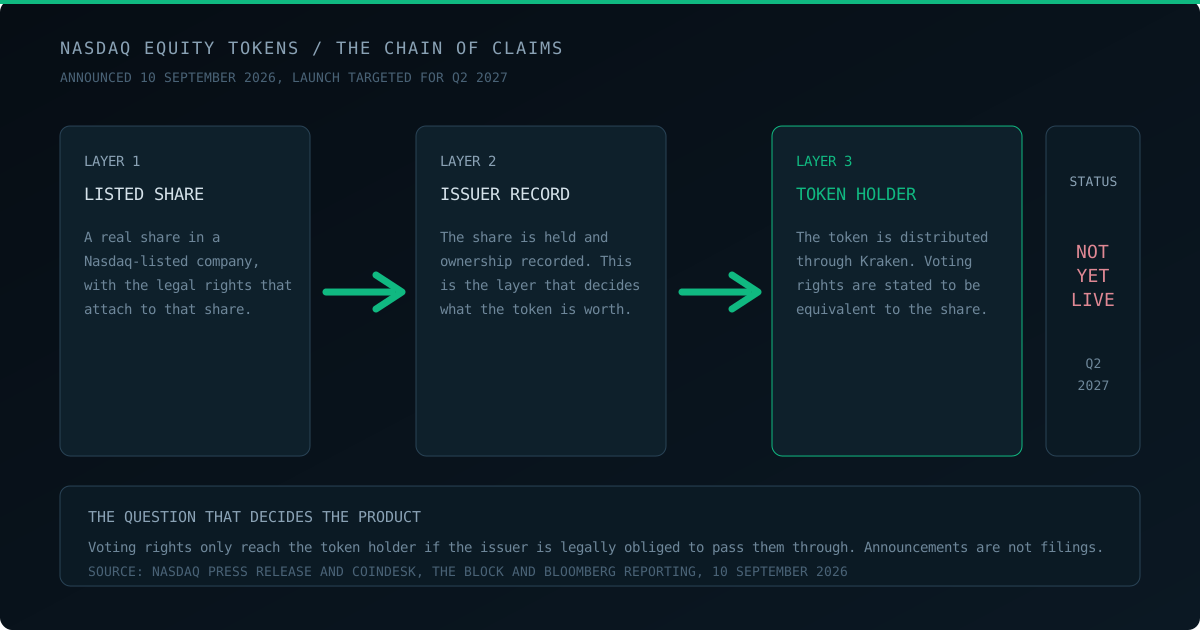
Most tokenized equity products sold to date are claims on an intermediary that holds the share. The token tracks the price, but the registered shareholder is the intermediary, and voting does not travel with a claim by default. Passing a vote through requires the issuer to be obliged to do it and to run the machinery for collecting instructions and submitting them by the record date.
So the useful question is not whether a token can vote, but who is contractually required to make that happen. CoinDesk reported that Payward will also integrate Nasdaq's market surveillance tools across crypto, equities, tokenized equities, futures and options. All of this is announced rather than live, and the documents that would settle the rights question are not yet public.
3. Today's Headlines
Producer prices rise faster than expected on energy
The Bureau of Labor Statistics reported that final demand rose 0.4 percent in August, with goods up 1.1 percent, energy up 4.2 percent and diesel fuel up 24.1 percent. Excluding foods, energy and trade services, the index rose 0.3 percent. Producer prices measure what sellers receive, so they tend to lead consumer inflation rather than confirm it.
Liquid restarts block production without transactions
Blockstream's status page recorded that at 10:00 UTC on 10 September the Liquid sidechain resumed producing blocks with no transactions while the network is monitored. Peg operations remain suspended and reserve restoration is still in progress, so the incident is contained rather than closed.
MoneyGram launches a stablecoin card in Colombia
MoneyGram launched its first stablecoin-backed Visa card, starting in Colombia and supporting USDC, built with card infrastructure firm Rain, wallet provider Crossmint and the Stellar network. It starts as a virtual card, with a physical version planned for late 2026.
4. Security Note: a real sender address proves nothing
Trezor said a breach at its external email provider let attackers send phishing messages from its own legitimate domain. The message, titled "Critical Security Alert: STM32 Entropy Vulnerability," urged customers to update their devices. BitBox reported a similar campaign the same day. Because the mail came from the real domain, sender checks passed. The defence is behavioural: never act on a security email by clicking its link, and never enter a recovery phrase into anything but the device itself. Open the vendor's site yourself and update firmware only through its official application.
5. From the Academy Library
Our cold storage and hardware wallet guide covers firmware updates and recovery phrase handling. For how listed markets and crypto venues differ in structure, read the beginner guide to crypto trading, or start at Academy School.
Bottom line: Tokenizing a share is straightforward. Carrying the rights that make it a share is the part that has to be built, and it has not been built yet.
Sources and further reading
- Binance: BTC 24-hour market snapshot
- Binance: ETH 24-hour market snapshot
- Alternative.me: Crypto Fear and Greed Index history
- Bureau of Labor Statistics: Producer Price Index, August 2026
- U.Today: spot bitcoin ETF daily flows for 8 and 9 September
- Nasdaq: deepening its relationship with Payward on tokenized equities
- CoinDesk: Nasdaq invests $100 million in Payward
- The Block: Nasdaq to invest in Kraken parent Payward
- Blockstream: Liquid security incident status page
- The Block: MoneyGram launches a stablecoin-backed Visa card in Colombia
- The Block: Trezor on phishing emails sent from its legitimate domain
Disclaimer: This publication is for education and information only. It is not financial, investment, legal, tax, or security advice.